Showing posts with label Modality. Show all posts

2013-03-07

Salty Suds

Epsom salts (which aren't actually salt but minerals, specifically magnesium sulfate) are salts that when added to bath water. They help relax, physically and mentally, by relaxing both the mind and muscles (see below for a more thorough explanation). The use of Epsom salts originated from observing the use natural mineral baths or soaking in hot springs to treat conditions in Europe.

Directions: Simply add a 1 cup (or 2) of the salts to a warm bath. Those with high blood pressure or those taking blood thinning medications should talk to their doctor before initiating this treatment.

Mental Effects: The body's magnesium levels get depleted during stress, causing fatigue both mentally and physically. When the salts are dissolved in the bath water, they are absorbed through the skin. When absorbed, they increased the level of magnesium in the body. Magnesium is a cofactor in the enzymatic reaction that produces serotonin. Serotonin is a bodily chemical that helps regulate our mood and improves overall energy.

Physical Effects: Magnesium is a known muscle relaxant. When absorbed into the skin from the bath water, the magnesium relaxes the muscles, making Epsom salt baths great for menstrual cramps, sports injuries, body pain, upper body muscle tension, and even constipation (especially if the constipation is linked to stress and an inability to "let go").

I was at Dollarama last month and saw them on the shelf for $1! So they are an extremely cheap treatment option. The one at Dollarama something looked like this:

Source here


Around the time that I saw these cheap (and effective!) salts at the dollar-store, was also when I had a disagreement with a teaching assistant (TA) over the cost effectiveness of naturopathic medicine.

I had said "Naturopathic Medicine is very cost effective" and the TA thought this was false. I still disagree. While some naturopathic treatments can yes be very costly and while seeing an ND ($100-150 for the initial visit, $80-100 for follow-up visits) is pricey, a good ND should be following the doctor as teacher principle: teaching the patient ways to take care of their health without relying in their ND for every ache and pain for the rest of their life. There are many, many frugal and sustainable health tips that a doctor can teach a patient during the first few visits that the patient can use throughout the rest of their life. Take my Naturopathic Pantry post for instance. Once a patient has been educated and guided by their doctor about simple and cheap home remedies, and aside from follow-up appointments with the ND, naturopathic medicine should be very cost effective as it relies heavily on lifestyle changes, and using items straight from nature to heal.

Next year, students will complete rotations in clinics that serve low-income and even homeless individuals. If we are able to help these patients, then cost-effective treatment strategies must exist!

Anywho, just my thoughts now. I'm curious to see how my outlook on the cost-effectiveness of my profession may change as I enter clinic starting in May!

2012-09-15

Physical Medicine.

The main naturopathic modalities that I will be using as a future ND include: nutrition (diet and supplements), botanical medicine, counseling, hydrotherapy, and physical medicine. 

When I first started at CCNM, and when these modalities were first introduced to me, I naively thought that physical medicine only consisted of massage and manipulation (aka chiropractic medicine). This year, however, I am learning that physical medicine is so much more! In third year, students take the course 'Physical Medicine'.  I've only had four classes of 'Phys Med' thus far, but boy have a I learned a lot of new therapies. 

Physical Medicine appears to be the best modality to body complaints; things like: sore muscles, sports injuries, strains, sprains, back pain, tension, nerve impingement, scars, etc. Phys Med involves a lot of pain management and techniques that encourage healing. 

Some of the Phys Med tools that we will be learning this year include (learning both theoretically and practically (i.e. hands on)):


Ultrasound: Not just an imaging technique, but a treatment too!  The ultrasound head sends sound waves through the tissue.  The sound waves cause internal vibrations, causing collagen re-growth promoting repair or increasing heat (heat is important in the tissue repair process, it means blood, hormones, growth factors, white blood cells (mast cells), and other repair elements are coming to the injury to fix it up). 

IFC (interferential current therapy): Very gentle electrical impulses are sent through the tissue surrounding the injury/pain. This low-frequency stimulation/vibrations causes the body to send healing factors (see above) to the site, helping to heal and relieve pain. 

Lasers: Similar to ultrasound and IFC, lasers use light beams to heal the damaged tissue/painful area by encouraging collagen regrowth and all those healing factors (see above) to the site. 


Who would of thought that sound, electrical current/vibration, and light could be so good for the body!

2012-09-13

Treament... and Dragons.


Real people with real health concerns. That is what this year is all about.  We are given cases in almost all of our classes. It is then up to us to come up with a diagnosis and a treatment plan (amongst other things, like what lab tests we should order, what next steps to take (future plan), etc).

For instance, today we talked about treating schizophrenia and anorexia nervosa using nutritional supplements. Yesterday, we talked about rhinitis (common cold) and influenza (flu) and how to treat these conditions using botanicals/herbs. Earlier in the week we talked about depression cases and using counseling/psychology as treatment. Lastly, we learned about muscle knots/trigger points and how to treat with either massage and acupuncture. It’s been quite the week of learning how to treat… and this is only the beginning.  I also love how naturopathic doctors have such big tool boxes; there are so many different ways (i.e. modalities) to treat one condition. 

Gone are the days of finding out what is wrong (diagnosis/pathology) and how it happened (pathophysiology). Here are the days of treating the root cause. I’ve officially reached the ‘treatment’ aspect of the curriculum. Yippee! 
_________________________________________________________


Image source here.

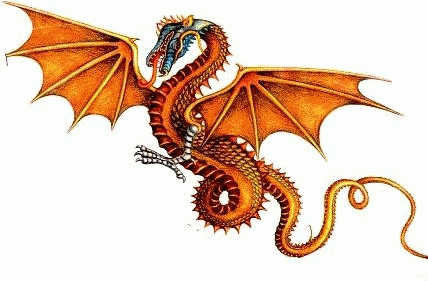
In other news, today I got to try some special acupuncture needling techniques today. For instance, we learned different ways to manipulate the needle while being inserted and removed in order to achieve different effects. I naively thought that there was only one way to 'jab a needle' into a body, but boy am I wrong.  There are tons of different techniques with funny names like 'building the mountain' and 'capture the dragon'.  Ha ha! Oh, TCM, you cease to amuse me.

2012-03-07

Integrative Medicine?

Naturopathic Medicine-is part of a broad group of medicines* often called Complimentary and Alternative Medicines (CAM). I attended a talk this week and the lecturer suggested that Naturopathic Doctors work to rename this umbrella term.

The lecturer explained how complimentary didn't quite fit as a description because it means that Naturopathic Medicine is there to compliment (meaning that it stands in addition to) regular, Allopathic Medicine. Complimentary implies that you must have Allopathic Medicine first, then Naturopathic Medicine as an addition.

Alternative
also doesn't work because it suggests that you can either have standard medicin OR the alternative. It's one or the other. Naturopathy really isn't that different from Allopathy (both have many of the same modalities and principles: both aim to help heal the patient, both diagnose, both offer treatment option). I also wouldn't call it alternative in the radical sense (although there are, sadly, still people who think we are Witch Doctors :P).

Instead of Complimentary and/or Alternative, the lecturer suggested that we adopt the term Integrative. Naturopathic Medicine integrates (or combines) typical medicine with more natural, less invasive therapies. It connects naturopathic healing with allopathic diagnosing techniques. Using the term integrative may help Naturopathic Doctors further include themselves in the standard health care system.

*Other professions included under the CAM umbrella: Massage Therapy, Chiropractic Medicine, Osteopathy, Herbalism, Holistic Nutrition, Physiotherapy, Midwifery, etc...

2011-12-01

Clinic Shifts and Cat Scratches.

Last night I had the privilege of following around a supervisor at CCNM's teaching clinic (the RSNC). During those six hours, I got to see fifteen patients! I observed lots of acupuncture, counseling, and quite a few manipulations/adjustments. One of the naturopathic modalities is physical medicine ; this modality features the manipulation of tissue, muscles, and bones. After third-year, I will know how to preform basic chiropractic techniques.

The bacteria Bartonella henselae can cause cat-scratch fever. Cats carry this bacteria; they acquire it from fleas and lice. When the cat bites or scratches a human, the bacteria is passed on, resulting in an papule or pustule developing at the bite or scratch site. The papule or pustule is benign (nothing to worry about), however fever and lymphadenopathy (swollen lymph nodes) may develop.

Image source here. I feel like this little innocent kitty is saying "Who me?"

2011-06-18

Other Medicines.

Orthomolecular medicine works to improve nutritional intake and/or prescribe supplements. Sometimes, it is known as megavitamin therapy as it can involve prescriptions of very high doses of vitamins, minerals, and other healthy molecules. A lot of naturopathic doctors use orthomolecular medicine within the nutritional modality of their practice. The word "orthomolecular" means the right molecules in the right amounts; therefore doctors practicing this medicine use the right nutritional supplements in the right amounts for their patients.
___________________

Osteopathic manipulative treatment (also known as osteopathy) involves the application of manual movements of the body to improve health, such as stretching, pressure, and resistance. These applied movements work the body's skeleton, vasculature, lymphatic system, muscles, fascia, etc. Often circulatory, swelling (edema), soreness, numbness, itching, pain, muscle contraction problems, and tissue problems are treated by osteopathy. Osteopathy is literally hands-on care. It involves using the hands to diagnose, treat, and prevent illness or injury.
___________________

Chiropractic medicine
treats problems with the musculoskeletal system, especially the spine. It is believed that spine disorders affect overall health as they directly impact the nervous system. Chiropractic treatments involve manual therapy, (such as the manipulation of the spine and joints) and soft tissue therapy (such as muscle and tissue manipulations).

2011-01-06

Ah, Sweet Friday.

Best of luck to many of my classmates who are competing at MedGames in Montreal this weekend. MedGames is an event where medical students from around Canada meet up to compete against each other in a variety of sports.

Another new class today: Clinical Nutrition. Nutrition is (so far) my favorite naturopathic modality (the other modalities are briefly discussed here). This class is way more than learning about fruits, veggies, and pseudograins: it is mostly focused on learning the clinical aspect of nutrition, focusing on nutritional deficiencies and treating illness with supplementation. Although I love nutrition, I'm not sure how much I am going to love this particular class because it was so dry. I was very bored even though I LOVE the material. Hopefully it gets better...

2010-10-05

Principles of Naturopathic Medicine.

First, do not harm.

Treat the causes of disease.

Teach the principles of healthy living and preventative medicine.

Heal the person as a whole using individualized treatment.

Support the healing power of the body.


As an aside, I went to the Art Gallery of Ontario not too long ago with a friend. I thoroughly enjoyed exploring the "Drama and Desire" exhibit. Everyday I try to do an activity that doesn't distractions or involve messages and/or advertisements being thrown at me. These activities allow me to think, reflect. For once I am not bombarded by the thoughts/ideas of others. Examples of activities that may help you to just think may include going to art galleries (on special occasions), cooking/baking, writing in a journal, yoga, sodoku or crossword puzzles, cleaning (for some!), gardening, walking, meditating, hiking, running, painting, and drinking or eating without anything in front of you but a mug or plate of good food.

2010-09-29

Modalities.

The modalities of naturopathic medicine include:

Nutrition. E.g. prescribing foods that heal, foods that prevent disease.

Herbal Medicine. E.g. herbs that help your body cleanse.

Asian Medicine
. E.g. acupuncture, herbs, tea.

Homeopathic Medicine
. E.g. correction of the root causes of diseases through remedies.

Physical Medicine. E.g. massage, water therapy.

Lifestyle Counseling
. E.g. work to understand and adapt a healthy lifestyle.

Through these six modalities, a naturopathic doctor will work to find the cause of disease and will treat the patient as a whole, helping his or her own body to heal itself.