Showing posts with label PCD. Show all posts

2013-03-24

Life Updates

- I have roughly one month left of classes until I enter clinic! It's going to be the last month I set foot in a classroom in my life... after twenty years of classes. Crazy.
- I start learning vitamin B12 injections tomorrow.
- I've made this pizza twice now. Awesome!
- I have my official clinic schedule for next year! I'm super happy with the shifts I have AND the supervisors who I'll be working under. I'll talk more about my shifts, satellites, and supervisors in a later post.
- I had my OSCE 3 on Friday. Here is how it runs: enter clinic room, greet patient, take their history (i.e. ask them a ton of questions about their health complaint), rule out emergent conditions and red flags, perform physical exams, diagnose the patient, recommend further testing/labs, and recommend a treatment for their condition ...all in 18 minutes ...all the while being marked/evaluated by a clinic supervisor who is sitting in the corner of the room ...then repeat this whole process two more times with two new patients. It was an adrenalin-packed hour that's for sure!
- I celebrated completed OSCE 3 by checking out this place with friends. Fun times.
- I think my OSCE 3 went very well. I was proud of performance(s). I have to pass OSCE 3 in order to enter clinic. Here's hoping the evaluators thought I was competent!

Caramel Apple Timbits

- I made these donuts yesterday (but since I didn't have a donut pan, I made "timbits" using a mini muffin tin).  They are pictured above.
- Anyone have nice Spring weather yet? While it's sunny out here, it is still cold.
- I walked into Bulk Barn this weekend: holy Easter candy overload! I forgot how sugar-laden this holiday is. However, seeing them all (an entire row of Eater candy only, by the way) brought make nostalgic memories. Malt chocolate eggs, foil wrapped chocolate eggs, jelly beans, gummy bunnies, mini eggs, caramel filled chocolate eggs... Om nom nom!
- I selected my clinic office for next year. I'm going to be sharing a room with two of my CCNM best buds

2013-03-18

PMI

The PMI (also known as the Point of Maximum Impulse) is the part of the body where the heart beat is felt the most. The PMI is felt best when you lie on the left side of your body, at approximately the 5th intercostal spaces (i.e. the spaces in between our ribs). On women, the left breast may need to be displaced upwards in order to find the 5th intercostal space. Simply count the spaces down from the clavicle until you reach the fifth gap. The diameter of the PMI is measured using finger pads. How many finger pads does it take to feel the whole span of the heart beat? Each finger pad corresponds to 1 centimeter (in metric units). A healthy PMI is 2.5 cm or less. An enlarged PMI may indicate cardiomegaly (i.e. heart enlargement).

Speaking of the heart, can you guess what this image means? 


(I have this image printed on a T. shirt, by the way)

2012-11-30

Fatigued?


We have learned that when a patient walks into your office and says "my chief concern is fatigue", we have to ask a bunch of questions to understand what they actually mean by fatigue.

What does fatigue mean to the patient? Does it mean:

 ...tired? ...sleepy? ...physically exhausted? ...apathetic? ...depressed? ...is there lassitude?


The descriptors above would each point the doctor towards a different diagnosis so it is very important to ask the right questions to make that sure he or she is going in the right direction when a patient presents with fatigue. 

Several examples of questions that may be asked to help determine the diagnosis: 

- Are you still fatigued after a good night of sleep?
- Do you feel well rested in the morning?
- Do naps help the fatigue?
- Tell me about your sleep. Is your sleep of adequate quantity and of good quality?
- Does the onset of the fatigue happen at the end of the day?
- How is your mood?
- How is the fatigued changed by exercise? Increased or decreased?
- Tell me about your diet. Are you consuming adequate calories, nutrients, and iron?
- Do you drink caffeine? How much and when?
- Etc, etc...

2012-11-01

The Naturopathic Gyne Exam

I performed my first gynecological (gyne) exam (on a real person, to a plastic model) this week! 


Yep, we naturopathic students are in trained to perform gynecological (gyne) exams, in addition to some other sex-specific physical exams, such as breast, prostate, and testicular exams.

To all my female readers out there: if you've ever had a bad experience when receiving a routine gynecological exam, I would suggest booking your next one with a naturopathic doctor.  I'm taking this opportunity to toot our own horn: a gyne exam performed by a naturopathic doctor can actually be a good experience (well, as good as a gyne can be!).  I have had a gyne exam performed by both an MD and an ND. Not trying to hate on MDs too much in this post, but the ND experience was a million times better.  Here is why:

1) Thorough - a full gyne exam actually has three parts. It seems, however, the most MDs only perform part 2 (the speculum exam), but that's only one piece of the puzzle! What about all of the other female structures? We NDs perform all three parts to fully assess the health of the female organs/sexual structures.

Part 1: an external genitalia exam (to assess the labia major and minora, glands, introitus, pubic hair, etc).
Part 2: a speculum exam (to assess the walls of the vagina and the cervix).
Part 3: an internal/external exam (to palpate the cervix, uterus, and ovaries).

2) Educational - we are taught to explain everything that is being assessed to the patients.  For instance, as NDs move throughout the three parts, every step is explained to the patient. The patient is a part of the process. When the doctor visualizes the cervix, they can offer the patient a mirror so that she can see her own cervix too (if she wants to see it, that is).  This will make the patient feel apart of the exam and more empowered about her body.

3) Patient First - we are taught to be extremely cautious with our language when performing this exam. We do not use any terminology that may make the patient uncomfortable. Also, at the beginning of the exam, we tell the patient that if any time she is uncomfortable, to let us know, and that if she wants to stop, we will stop immediately.  By explaining every step of the exam to the patient before the exam begins and as the exam transitions from step to step, the patient is made aware of what is happening, which hopefully will make them feel a little bit more comfortable during what is inherently a ridiculously uncomfortable exam.

2012-10-23

Pulses.

Image source here

What is a pulse? It is a reflection of the heart beat, but more specifically, it is the pulsing of arteries as blood is pumped through them.  You can palpate a pulse by pressing a large artery against a bone in the body. Arteries are surrounded by thin layers of muscle that expand to allow blood to pass through it and contract to propel the blood to the next location.

Why listen to our pulse? We can get valuable information about how hard our heart is working by 'listening' to the pulse.  Try this mini exercise: next time you feel stressed, palpate your pulse. Try to describe it (rapid, quick, etc).  Then, right before you fall asleep, as you are lying in bed, palpate your pulse again. How is it different? I'm guessing your pulse will be slower and gentler before bed, compared to the race-y, fast-paced, and stressed-out heart beat that you felt earlier.

Another reason to listen to our pulse (especially in varies places of the body): if we are suffering from any type of occlusion/blockage, a particular pulse may feel weaker, diminished, or even absent! For example, people with very poor circulation may have fairly faint feeling pulses in their feet (the dorsalis pedis pulse, #9).  

We have many areas on the body where you can palpate your pulse: 

We have the temporal pulse (1, on top of our temples), the carotid pulse (2 and 3, on the front of our neck, never palpate these at the same time!), the brachial pulse (4, in the crease of our elbow), the radial pulse (5, on the wrist below the thumb), femoral pulse (6, in the crease of the leg/torso), popliteal pulse (7, on the back leg, opposite to the knee), dorsalis pedis pulse (9, on the front of the foot), and posterior tibial pulse (8, on the inside of leg, above the ankle). 

*If you are looking to find a particular pulse, leave a comment and I can describe its location in more detail than I have given above. 

2012-08-12

Babinski.

Image source here.
The Babinski test is a fun little test I learned about in first year, during my practical physiology tutorials.  I think it is a cool concept and couldn't believe that I hadn't shared it on the blog yet! 

The Babinski test consists of someone stroking the lateral side---of the bottom of the foot, going in the direction of the heel to the toes---with a blunt but somewhat sharp object.  (If you want to try this test at home, perhaps you could use a capped pen or a smooth chopstick? Doctors often use the end of their reflex hammer to preform this test).

When the foot is stroked in this matter, the normal adult reflex is for the toes and foot to all curl downwards (a motion termed plantarflexion), as seen in image A

However, in people with upper motor neuron lesions of the corticospinal tract (i.e. people who have had a part of their spinal cord damaged), there response will be much different. Instead of the toes curling, they will fan outwards, and the big toe with extend backwards (a motion termed dorsiflexion), as seen in image B. If patients are experiencing neurological or motor abnormalities, the Babinski test can be preformed to potentially narrow down the location of the spinal cord problem.

The coolest part of the Babinski test is that when it is preformed on babies, their toes will fan out just like image B.  This is because their corticospinal pathways haven't fully developed yet (they are not yet myleinated). In the healthy baby, this abnormal reflex will disappear sometime before his or her second birthday.  

Any readers with babies should give the Babinski test a try.  It's a reflex that your babe will only have for so long!

2012-05-18

The Broken Trachea.

“You broke his trachea” says an NYPD cop. “I didn’t know a trachea could break” says Luke. 

Quote from the new action movie Safe.   

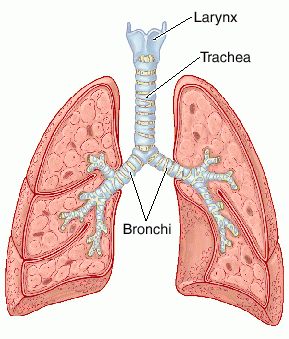
While I haven't seen the movie Safe, I heard this movie quote in a commercial for the movie and found it pretty amusing. A bit about the trachea: it is located in our neck (pictured below).  It is our breathing tube or our wind pipe, facilitating the air's passage between our mouths and lungs.
 
Image source here.

The interesting thing about the trachea is that the trachea actually does move (and yes, it can even break like the movie suggests), especially when there are underlying lung problems.  During a ear/nose/throat, head/neck, or lung exam, the trachea is examined by the doctor to see that it is midline. Two major pathologies that are associated with deviated tracheas: 1) lung punctures (pneumothorax), in which the trachea is deviated away from the punctured lung (so it moves to the far right of the neck if the left lung is punctured). 2) Atelectasis (collapse of lung alveoli), in which the trachea moves towards the affected lung (to the right when the right lung is diseased).

2012-04-16

Best Part(s) of My Day.

Best part of my day: Got to ask patients questions! I love the conversation/interview aspect of  appointments. Much better than the physical exam aspect.

...no, wait! Best part of my day was: Wearing a white coat & toting around medical equipment, like a boss.
  
...no, wait! Best part of my day was: Feeling very confident in the assessments of my two patients.  

...no, wait! Best part of my day was: Today's high of 25*C.  Hello warm weather!

...no, wait! Best part of my day was: Realizing that I only have three major exams left on the road to becoming an ND (OSCE 3, NPLEX 1, and NPLEX 2 remain... OSCE 1 & 2 are done and done!)

Worst part of my day: The subway breaking down on the way to my biggest and most important exam of this semester, resulting in me having to run to my exam in order to make it on time (and feeling like I was 'dying' from the additional stress that the subway stall added to my already stressed state). Not fun, but in hindsight it's a funny story to tell!

Overall, 'twas a good day.  A good day indeed given the circumstances. Hope your Mondays had best parts too!

2012-04-15

It's OSCE Time!

Tomorrow is my OSCE exam (I talked a bit about OSCEs before on the blog, here is one entry and here's another) ...and I am pretty nervous!  This exam pretty much summarizes everything I learned over this past year. All of the year's material is evaluated at once in this massive exam (this practical exam takes 1.5 hours to complete and consists of three stations).

There is a diagnostic station (listening to heart sounds, lung sounds, palpating breast and genital simulators, looking into fake ears and eyes, charting, etc) and two case stations.  In the case stations, I will be presented with a real patient and a case (patient complains of diarrhea, fatigue, sore throat, etc).  It will then be up to me to ask the right questions and perform the right physical exams in order to diagnose the patient.  

Can we say nerve-wrecking?! Anywho, confidence is key in this exam, so I just have to muster up the courage and calmness and it should all be fine. In the meantime, here are some laughs to lighten the mood: 


2012-03-20

Let's Play Doctor.

Wonder what is hiding in this fake ear?

Looking into the fake eye to see what is going on with the retina.

An example of what could be in the fake eye: an image of a retina damaged by hypertensive retinopathy.

Today I spent the afternoon in CCNM's dry lab. In this lab, there are all kinds of equipment and simulators that budding doctors can use to practice their diagnostic skills. For instance, you can use your equipment to peer into the ear and eye and detect pathologies. Above are some snap shots from my playtime (err, I mean practice time).
____________________________________________________________

In other news, I learn about yet another new way of treating diabetes: with spit!

Lizard spit (saliva) is being used to treat diabetes (type 2 only). Spit from the Gila monster lizard has been used to make a new type of drug, which will belong to the drug class incretins (incretins amplify the effect of insulin). They will be available for use this coming June. This drug must be injected twice a day and can cause nausea.

I wish I knew what inspired the researchers to give lizard spit a try... so odd. But apparently Gila monsters have hormones similar to human glucagon-like peptides (incretins) which is why their spit (containing their hormones) does work as drugs for humans.

n

2012-03-08

Women's Week.

This week has been all about women.

On Monday, we learned how to preform breast exams. In CCNM's teaching clinic, in groups of 3 or 4 students, under the supervision of a Naturopathic Doctor, we were able to practice performing the exam on real patients. I must say is that the "Naturopathic" breast exam is much more in depth than an Allopathic breast exam. The exam should take 2-3 minutes per breast and it covers not just the breast tissue, but the entire rectangle of skin between the clavicle, sternum, 5th rib, and the midaxillary line (aka the imaginary line that runs through the center of the armpit downwards). Breast cancer can metastasize anywhere within this rectangle area, so Naturopathic Doctors are thorough with their technique to detect any abnormalities that may be present.

On Tuesday, I had the wonderful opportunity to attend a women's only hydrotherapy spa. I've been wanting to attend this venue since I took my Hydrotherapy class last year. Clothing at this spa is optional, but I wore a bathing suit :P I alternated between warm, very hot, and freezing cold temperatured pools, saunas, and steam rooms. This alternating hot and cold circuit allows the body to be 'treated' by the waters. I loved the experience, even though some of the circuit steps were far from relaxing; stimulating may be a better description. My skin felt incredible and I slept like a baby once I got home that night: it just goes to show how therapeutic water can be!

On Wednesday, we learned all about the female genital organs (vagina, uterus, ovaries, etc), including relevant pathologies. We were also (briefly) taught how to preform the female pelvic exam. Next week we'll be able to practice using plastic simulators. We won't be able to preform a true pelvic exam (on a real patient) until third-year.

Lastly, Thursday (today) is International Women's Day (if you want to learn more, check out Google's front page). I recognize the importance in celebrating the progress that has been made in bringing men and women to the same level; however I consider myself more of an equalist. I want to see men and women treated equally, meaning that for every Women's Day, shouldn't there be a Men's Day too? Nevertheless, today's holiday is a nice way to end my women's health-themed week.

Image source here.

2012-02-15

Did You Know...

...one of the reasons why gun bullets kill is because they allow the pathogen Staph aureus to enter the body.
...dwarfs/little people have normal sized heads because dwarfism only affects cartilaginous bones and the skull is not a cartilaginous bone.
...people with osteogenesis imperfecta (brittle bone disease) have blue eyes (sclera) because they have abnormal collagen synthesis and thus thin collagen in their eyes that allows underlying veins (containing deoxygenated "blue blood") to be visible, giving the eye a blue tinge.
...changes in the weather can cause increased discomfort and pain for some people due to the changes in barometric pressure. Especially in people with arthritis.
...foot pain can cause headaches. Some people's headaches relieve when they are given proper orthotics.
...hygiene is important, but not just physical hygiene. Don't forget sleep hygiene, food hygiene, and emotional hygiene. How are you "cleaning yourself" from bad thoughts and negativity at the end of the day?
...that you can get a headache after you wash your bed sheets. The harsh chemicals in detergent still linger the first night you sleep in clean sheets. If you are sensitive to chemicals/fragrances, this could trigger a headache. Try to wash sheets in the morning to let them "air" before bed or switch to fragrance-free detergent.
...when a doctor examines the inside of your eye (the retina) he or she is technically looking at your brain (he optic nerve is a visible nerve and is an extension of brain matter).
...muscle twitches may be a sign of low calcium.
...maximum bone density is reached at age 30, then 0.7% of bone is lost each year after this age.
...acetylcholine is a neurotransmitter important in memory function. Boost your acetylcholine levels by eating eggs and soy lecithin (found at health food stores and is most dark chocolate bars).

2012-01-23

Cranial Nerves.

There are twelve cranial nerves (aka nerves in the head). Each has nerve has a specific role and its function can easily be tested. Below is a summary of each Cranial Nerve (#) - what it does - how to test function.

#1 – smell – test sense of smell (using an essential oil or rubbing alcohol).

#2 – visual acuity and fields – test visual acuity (Snellen eye chart) and look into eye using opthalmoscope.

#3 – pupillar (pupil) reactions – inspect size, shape, and functioning of pupils.

#4 (along with 3 and 6) – extraoccular (eye) muscle movements – test eye muscle movements

#5 – corneal reflexes, facial sensation, jaw movements – palpate temporal (temples) and masseter (cheek) muscles with teeth clenched, examine jaw movements, look for normal eye blinking, and test for face pain perception.

#7 – facial movements – note symmetry of the face, ask patient to
raise eyebrows, frown, close eyes tightly, show upper and lower teeth, puff out cheeks, and smile (testing face muscles).

#8 – hearing – whisper near patient to test their hearing.

#9 (and 10) – swallowing and gagging – say "ah" to see soft palate rise, move the tongue, and test gag reflex.

#11 – shoulder and neck movements – shrug shoulders and turn head to each side against resistance.

#12 – tongue – inspect the tongue and ask patient to say "light, tight, dynamite" to test tongue movements.

Image source here.

2012-01-15

Colored Stools.

WARNING: don't read this post if you are presently eating or have a sensitive stomach! It may prove to be gross/graphic for some.

A healthy stool (aka poop :P) color is a shade of brown. If stool is black or bright red, then there can be bleeding along the gastrointestinal tract (upper GI and lower GI respectively) due to infection or disease (please talk to your health care provider if you detect black or red stools). However, stool can turn other colors depending on what is consumed. If you eat a lot of the following products, you may see a change in stool color:

Gray stool = chocolate.
Dark green stool = grape-flavored products.
Green stool = leafy green veggies.
Black stool = iron supplements, charcoal, licorice, lead, some berries, or blood (see your doctor!).
Pink, red, or purple stool = beets, cranberries, tomatoes, red peppers, food dyes (often found in candies), hemorrhoids, or some medications.
Pale/White (chalky) stool = antacids (like Tums), malabsorption, bile production problems, gallbladder problems, liver problems (such as liver obstruction).

***ETA: Blue stool = Smurf ice cream :P

Image source here. Information source from my PCD textbook found here.

2011-12-04

Honey Pee.

Diabetes Mellitus

(I'm sure the Blue Prince and baby H both already known all about this; they're the experts on this topic, not I!)

The word mellitus is the latin word for "sweet as honey" (also the French word for honey is miel). Honey pee is what doctors used to describe the urine of a diabetic patient. When the body has too much sugar and is in a state of hyperglycemia, the kidneys stop filtering out glucose and let the extra sugar be secreted into the urine. This makes the urine sugary. Back before labs were readily available, doctors used to taste the pee of a patient they suspected had diabetes, and if it tasted sweet, there hypothesis was deemed correct. Aren't I glad that I can now order glucose-tolerance tests from laboratories instead of tasting my patients' urine if I suspect diabetes :P

Image source here.

2011-11-24

Hypertension Target Organs.


Hypertension (aka sustained high blood pressure) is called the Silent Killer because it can degrade health in a slow and less than obvious way. Hypertension can act in the "background", degrading many organs. For this reason, I have been taught to preform full physicals on patients with hypertension to monitor their target organs. It's amazing how interconnected the body is; when you suffer from one health concern (e.g. hypertension), the whole body can be at risk. More on hypertension here.

Target organs and what I would look for during a physical exam:

Neck - increased jugular venous pressure, goiter, look for the jugular veins pulsating more than normal, listen to carotid arteries for bruits
Skin - look for excessive bruising, edema, striae (a sign of Cushing's syndrome), and/or hirsutism
Eye - hemorrhages, cotton-wool spots, exudate, nicking, copper wiring, or narrowing on the retina, papilledema (swelling of the optic nerve)
Lungs - look for masses, pulmonary embolism , chronic cough
Heart - hypertrophy (increased in size), murmurs, extra heart sounds (S3 and/or S4)
Abdomen - coarctation of aorta (blockage of major artery passing through abdomen)
Kidney - increase in size, renal artery blockage and bruits, polycystic kidney disease

2011-11-01

Nail Clubbing.

Happy November! Hope you are all functioning well despite last night's sugar high. I saw lots of cute kiddos in their costumes last night. Such a fun holiday.


In my Physical and Clinical Diagnosis (PCD) class (basically my physical exam class) we keep learning how no matter what physical complaint the patient has, that the skin, hair, and nails of the patient most definitely should be examined. It is unbelievable how many unassociated conditions can affect these areas of the body. For instance, nail clubbing is a phenomenon in which the fingers on the nails start to swell and balloon out. It almost looks as if marbles have been inserted in the ends of the fingers as they start to appear round and swollen. Clubbing is painless and will subside once the underlying condition is treated. Now what is odd is that nail clubbing is usually a side effect of a LUNG or HEART condition. Crazy how a chest condition shows up in the most distal part of our upper extremities! Unfortunately the reason WHY these conditions are associated with nail clubbing is still unknown... sometimes the body works in mighty mysterious ways.

However, there are four main theories behind the etiology of clubbing: including the production excess vasodilators, tissue hypoxia (i.e. lack of oxygen in the finger tissue), a neurocirculatory reflex, or due to some abdnormal genetic factors.

Here is how I'm making sense of the condition: when the lung and heart are distressed and thus lower in oxygen (hypoxia), they secrete vascular endothelial growth factors. These growth factors then act on the distal ends of the fingers, causing excess growth and swelling. Another hypothesis is that the capillaries in the nail are altered by the lung and heart condition. These vessels may lead to edema of the connective tissue in the nails, causing the enlargement.


To diagnose nail clubbing, an easy test can be preformed: place your two index finger nails on to of each other, such that the two fingers face each other and the nails touch. In between the two nails, there should be a teeny-tiny diamond-shaped space. If this "diamond" of space is present, then the nails are of normal shape and no clubbing is present.

Image sources here.

2011-10-25

Cooking Up a Storm.

How does Becca celebrate the end of midterms? With a cook-off, of course!
When I upload my pictures of these creations, I will post the accompanying recipes. My weekend cooking included:

Hummus
Strawberry "Cheesecake"
Homemade Mocha Lattes
Spiced Mung Bean Stew
Chocolate Almond Butter Cookies
Seedy Bread

Now who wants to volunteer to do my dishes?


In more medical news, I am getting really good at inspecting eyes and ears using my ophthalmoscope and my otoscope. I am able to see into the retina (of the eye) with minimal hiccups, and the tympanic membrane (of the ear) comes quite easily now. I am loving my Welch Allen equipment and am loving observing the hidden anatomy of the human body!

Image source: http://www.welchallyn.com/promotions/PanOptic/

2011-10-03

PCD Competencies.

In my Physical and Clinical Diagnosis (PCD) class (which I have every Monday morning), I am expected to learn:

- How to interact with patients as a sensitive and caring medical provider
- How to have professional doctor-patient interactions
- How to take a full medical history
- How to preform a head-to-toe physical examination
- How to use all of my medical equipment properly during the physical examination
- How to preform a review of systems (ROS) physical examination
- How to analyze the findings of a physical examination
- How to recognize normal versus abnormal findings
- How to recognize "red flag"/emergency referral findings
- How to preform proper inspection, palpation, percussion, and auscultation techniques

2011-09-30

Vitals!

In clinic on Wednesday, I was able to measure the vitals on a real patient in the teaching clinic on campus (the Robert Shad Naturopathic Clinic). Vitals include: measuring blood pressure, calculating respiratory and heart rate, and taking temperature.

Let the doctor-patient interactions begin!