Showing posts with label TCM Organ. Show all posts

2012-12-11

The Lung Loves Pungent

Pungent foods have an affinity for the Chinese (TCM) organ, the Lung

Why are pungent foods paired with the lung? 

Hmm, well, maybe because these are the types of foods that you want to eat a lot of (garlic, ginger, onions) during colds and flus (i.e. sicknesses that affect the lung)... Maybe because these foods can sometimes make you cough, therefore they interact with the lung by stimulating cough receptors... Maybe because these foods are a bit spicy, causing vasodilation, opening up the lungs and sinuses...

Or, maybe because the TCM theory just says so :P  Sometimes it is best to not pick-apart every aspect of TCM and just go with it!

Wasabi and ginger: two pungent foods.

Examples of pungent foods (all of the foods that have a little 'bite'): 

Garlic, clove, black pepper, ginger, mustard, horseradish, wasabi, raw onions, etc.

2012-03-09

It's that "Change of Season" Time Again.

According to TCM theories, we are smack-dab in the middle of the another Change of Season (the changing of Winter to Spring). The last 18 days of a season are transition days and are also Earth element days, which may be why my Spleen has been acting up (Spleen is an Earth organ).

This time of year is hard on our bodies because the weather is very wonky (it was +14 and sunny on Wednesday, then today it was -2 and snowy), confusing our bodies and immune systems. Try to take extra care of yourself until Spring starts (March 21). With all of the wild wind these days, don't forget to still wrap yourself in a scarf before leaving the house. Now is also a good time to make a batch of Change of Season Soup if you have it on hand (I hope to sell packages of this soup mix at my future practice; it is tastes surprisingly pleasant and is very soothing).

In celebration of the Earth element, I decided to try making congee. One classmate of mine has this porridge-style dish every morning and I've been wanting to try it for awhile now. Another classmate recently posted a savory version of the dish here. Well, my troubled Spleen (see above) finally gave me the kick-in-the-butt I needed to get into the kitchen and make it myself! Congee is a slow-cooked porridge-like dish made of rice and water. It is a popular dish in Asian cultures. Rice is cooked very slowly and for a long time to fully cook the rice; cooking it until it resembles... mush. The point of this dish is that the rice has been cooked so long that it is basically digested, making it very easy to eat when the Spleen (the organ responsible for digestion) needs a break. When served warm with some spices (think cinnamon and ginger), it is very soothing and warming. Comfort in a bowl!

Basic Breakfast Congee
1 cup brown rice
10 cups water

Bring the water and rice to a boil, then reduce to low heat. Cover (leaving a tiny gap for steam to release) and let it cook on low for five hours. Serve warm with cinnamon and ginger (chopped fruit--like dates or raisins--and nuts or seeds are all optional toppings). Makes 6 servings. Reheat leftovers before serving (the Spleen likes warm foods!).

2012-02-21

Chocolate Fix.

"Whoever said laughter is the best medicine had clearly never tasted chocolate".

Exams start today, so you can imagine what I've been eating way too much this past week in preparation: CHOCOLATE! I've got to thank/curse my tired-of-studying spleen for that one.

Here are three chocolate bars that I am currently loving and recommending:

My go to chocolate bar is Lindt 90%. It is heavenly if you love dark chocolate. Rich, smooth taste, with just enough sweetness. Most people consider me crazy for eating 90%, so I will also recommend the Lindt 70% because it is also super good and I think more people would like it. Lindt chocolate bars are great because they are cheap (usually 2 for $5 when on sale) and available everywhere (even my neighborhood convenience store sells them).

For milk chocolate lovers, I want to recommend the Terra Nostra Ricemilk Chocolates. These bars are crazy because they taste just like regular milk chocolate, but they are made of rice milk. Very cool that dairy-free milk chocolate exists, and they even happen to be organic!

And last, but not least Endangered Species Chocolate. Recommended to me by reader M, this is my new favorite chocolate for a number of reasons: they are ethical, have clean ingredients yet an amazing taste, and are sugar-free chocolate (sweetened with beet sugar). The Extreme Dark variety is the best, but the Chocolate with Mint is a close second. I would eat this chocolate everyday if it wasn't so hard to find (I need to travel to fancy health food stores to find them).

Pictured above: a chocolate bar that my Momma bought me over the holidays. Loved the caption!

2012-01-09

TCM Organs: the Lung.

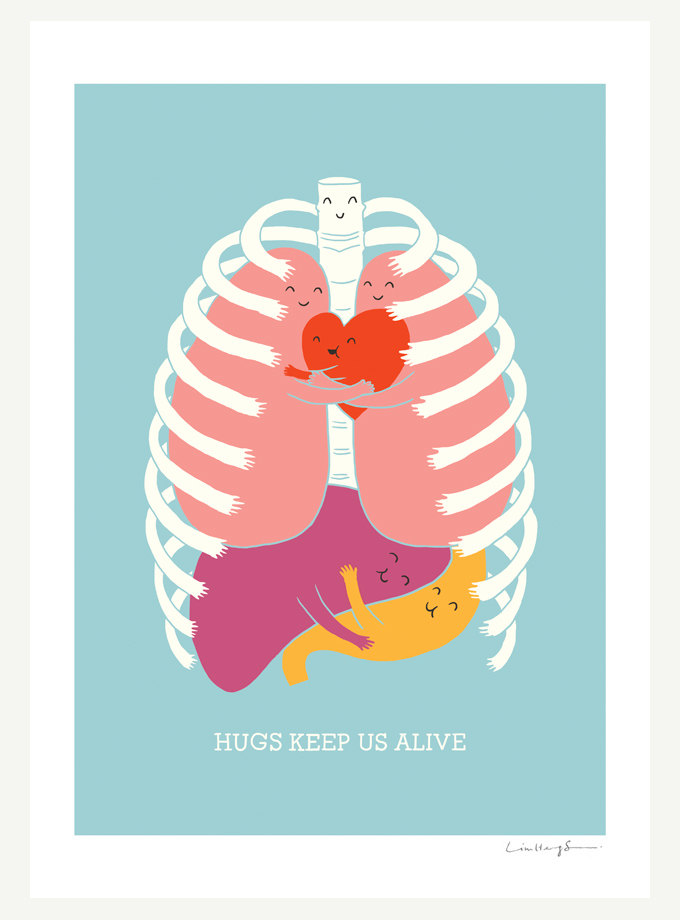
I'll conclude the discussion of TCM organs with this adorable picture. 'Tis true: hugs really do keep us alive :)

The last major TCM organ: the lung, the organ that...

...governs mucous secretion
...expresses sadness and grief
...causes us to enjoy pungent flavors
...makes us cry when it is weak
...controls smell
...regulates respiration (obviously)
...regulates Qi (our energy)
...descends and disperses our energy throughout the body
...controls skin, pores, and body hair
...controls our initial immune system defense mechanisms
...houses our "soul"

Image source here.

2011-12-20

More Kidney Love.

Tomorrow marks the start of my annual Xmas blog hiatus. Nine exams have come and gone, now I'm taking a break, including the next two weeks of blogging. I'll be back in January (5th-ish) with lots more medical fun.

Enjoy your holidays!
~ Love Becca

But first I'll leave you with some more adorable kidney action:

As if Hello Kidney wasn't cute enough...


...may I present plush kidney:


...and kidney cake pops (yep, those are kidney decorated pieces of cake)!

Image sources here.

2011-12-05

TCM Organs: the Spleen.


The spleen is my favorite TCM organ (probably because I am chronically spleen Qi deficient, so I like learning about my "weak organ"). Also, the spleen is the TCM organ most related to Nutrition, which also happens to be my fav naturopathic modality. I have already talked about the spleen here, so there will be overlap... sorry.

- The main role of the spleen is to transform food into energy (aka digestion!).
- A healthy diet means a healthy spleen.
- All students use overuse their spleen because it is responsible for our intellect. Thinking, thinking, and more thinking requires lots of spleen energy!
- As a result of the spleen's intellect and digestion roles, we think better when we eat better. McDonald's for lunch? Hello brain fog!
- The spleen rebels when we don't eat, causing headaches and nausea.
- The spleen controls our muscles and limbs. Muscle weakness is a spleen sign.
- The spleen's emotion is worrying. Worry-worts are likely spleen deficient.
- The spleen controls the movement of blood throughout the body. Circulatory disorders are thus spleen.
- The spleen controls taste.
- The spleen opens into our lips. A weak spleen means dry or cracked lips.
- The spleen functions best when we eat nutritious and seasonal food. Soups and stews in the colder, salads and smoothies in the warmer months.
- The spleen loves sweetness, but not too much. Too much sugar harms the spleen and all its associated functions (eat a giant piece of cake and pay attention to your lips the day after). A bit of sweet helps the spleen with digestion, so a tiny dessert is ok after dinner. On that note, artificial sweeteners (stevia, aspartame, sucralose, etc) are harmful because they trick the spleen (and in fact the entire digestive tract); the spleen tastes sweet, so it thinks sugar is coming, but it never comes...
- Craving chocolate while studying for exams? That's the spleen talking as all of you intellect is being used-up and it needs more fuel! (However, don't totally give-in to the craving or your future studying will be impaired, just a wee bit to give it a boost).

Image source here.

2011-12-03

TCM Organs: the Heart.


- The heart's emotion is joy. A heart pathology can exist when a person experiences a lack of joy (like in depression) or excessive joy (like someone who is a joker, laughing at everything, ending each sentence with a nervous giggle).
- The heart stores our mental/emotional blood. Our emotional thinking comes from the heart.
- The heart controls the mind (but not our intelligence, that's the spleen's job)
- The heart opens onto the tip of our tongue.
- Heart problems include insomnia and mental restless (because the mind is agitated and won't settle down).
- The heart manifests in the face. When someone's heart is glowing, it shows in their bright and happy face. On the other hand, someone experiencing lots of doom and gloom may have a dull, pale/grey, and/or sad looking face. Facial acne may be a sign of heart pathology, but could also be a lung issue as the lung controls skin).
- Lastly, the heart controls our blood vessels and the movement of blood.

...Only two TCM organs remaining, the spleen and the lung!

2011-11-29

TCM Organs: the Kidney.


Cutest picture ever! It is amazing what creative pictures you can find on the net.


Today I present you with information on the TCM kidney:

- salt is the kidney's preferred flavor as salt is related to water balance (water balance is the kidney's primary function).
- the kidney is connected to the lung as they are both responsible for the body's water balance. As a result of this relationship, when the kidney is distressed, the patient will yawn a lot, drawing in air via the lungs.
- the kidney stores essence. Essence is our internal fire, the one that drives our growth and development. We have lots of essence when we are young, but as we grow old, we lose essence. Essence also allows the body to reproduce and produce offspring.
- the kidney manifests in head hair. Thinning head hair means less essence and a weaker kidney.
- the kidney controls our will power. Those with strong will power have strong kidneys.
- the kidney opens into our ears. As we age, our hearing declines as we have less essence and weaker kidneys.
- the kidney houses our yin and yang energy; we have one kidney for yin (our right kidney) and one for yang (the left kidney).

With all of that liver talk from yesterday and today's kidney discussion, I am guessing that my readers are quite confused. Sorry, but I find it hard to explain TCM in writing. Trust me when I say that TCM does make a lot of sense and is quite fascinating.

2011-11-28

TCM Organs: the Liver.


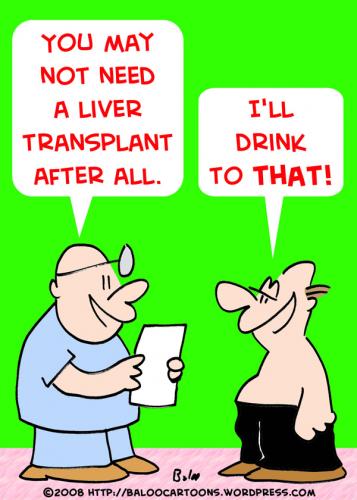
Remember when I talked about drinking alcohol to release anger? Well, I've since learned a lot more about the Chinese "liver". In the upcoming week or two, expect a post on the other big TCM organs (spleen, kidney, and heart). In the meantime, may I present the TCM liver:


- main emotion is anger.
- opens into the eyes. This is why after a bit of alcohol (a wee bit of alcohol is good for it), our vision becomes sharp. However, after too much alcohol (too much is a bad thing), our vision is blurry.
- involved in exhalation. When we are angry, we exhale a lot more (think of huffing and puffing). When we are frustrated or mad, we may sigh more often. As the liver (and anger) is linked to breath, breathing exercises are helpful to control anger.
- when the liver is acting up, you tend to talk a lot. Lots of rambling.
- loves bitter foods, think leafy greens, coffee, and herbs.
- grain alcohol (i.e. beer) stimulates the liver well as grains are bitter. Bar fights tend to break-out at last call or when the bar is closed because there no more alcohol is served to fuel the liver, thus anger gets loses control.
- holds physical blood; helps regulate menses.
- helps control the smooth flow of energy in the body. Again, when we are angry, our energy "boils up" and obviously doesn't flow easily.
- does our life planning.
- controls tendons and ligaments. Athletes with tendon and ligament injuries should have their TCM liver treated.
- in terms of TCM pathologies, liver qi stagnation is the most commonly diagnosed condition in the Western world.

Joke source here.