Showing posts with label Treatment. Show all posts

2013-04-19

Breast Cancer Causes (?)

Today, the most prevalent types of cancer in Canada are lung, breast in females, prostate in males, and colorectal/colon cancer (Source). So, let's chat about breast cancer for a second or two. While no one can pinpoint exactly what causes this type of cancer, there are several hypotheses behind the increased incidence of of breast cancer as of late: 

Plastics: plastics contain synthetic estrogens (xenoestrogns) which are endocrine distruptors, causing all kinds of endocrine disruption in the body (affecting not just the breast, but also the thyroid, adrenals, prostate, and more).
- Not breast feeding: not using the breast the way it was physiologically intended). Source.
Genetics: the BRCA1 and 2 genes. Source.
Shift work: Due to low melatonin levels due to odd nighttime light exposure (i.e. working at night) has recently be linked to breast cancer. Shift working nurses, in particular, are at risk of developing breast cancer. Source.
- Anti-perspirants: by applying these to the armpit, where is very close to the breast tissue. These products contain aluminum (a heavy metals), synthetic chemicals, and toxins. They stop sweating, but sweating is one of the body's mechanisms of detoxification. As we are not able to sweat wearing these products, the toxins that would normally leave the body through sweat, need to go somewhere... and since the breast is near by and fatty tissue to deposit in, toxins accumulate in the breast. We talked about this in one of my classes (Men's and Women's Health), but here is another source. By the way, "deodorants" don't really exist anymore. Almost all "deodorants" on the market are actually anti-perspirants; blocking perspiration.
- Bras: we didn't always wear bras, that's a new societal development, especially those with metal underwire. While there isn't any research to support this claim, there is a lingering hypothesis that bras compress the breast and that their underwire doesn't allow the lymphatics of the breast to properly drain. Whether or not this is true and is linked to breast cancer, tight clothes is not normally good for your body. For all my female readers: tonight, when you undress, take off your bra in front of a mirror. If there are bra indents/red marks on your skin after the bra is off, then it is too tight! When choosing bras, try to get ones without metal underwire if you can and make sure your bra is properly fitted (i.e. not too tight but still supporting you well to prevent sore necks/traps/back).
- Lastly, all those other cancer risk factors, like smoking, lack of exercise, obesity, stress, etc, etc, etc... 

Now that we've got the risks out of the way, here are some ways to improve your breast health!

- Massages: massage the breast, moving upwards, towards the clavicle to drain the breast lymphatics
- Consuming phytoestrogens, like soy and flaxseeds, on a regular basis
- Avoiding plastics as much as possible
- Wear a properly fitting bra and try for bra-free days if possible (weekends?)
- And all those other health promoting practices, like not smoking, exercising, getting enough sleep, maintaining a health weight, managing stress, eating well ...yadda, yadda, yadda!
- Talk to your doctor to learn more ways to keep your breasts healthy. This blog post was not meant to scare anyone into thinking that they are going to get (or got) breast cancer due to behavior X, Y, or Z, instead it was meant  to getting my readers thinking more about their overall breast health!

2013-04-17

Semi-Salty

Those who are mindful of their sodium intake also have to watch out for "hidden" sources. Ketchup and bread are both high in sodium and are often forgotten about. This cute "dip or squeeze" ketchup packet was seen in a restaurant; the package is cute, but the product still sucks.  :P

In my last Integrative Therapeutics lecture on Monday, we wrapped up our discussion of treatment options for cardiovascular disease, congestive heart failure, and hyperlipidemia. We also chatted about hypertension (though we had already completed a model on treating hypertension, aka high blood pressure, earlier in the semester).

We broached the topic of salt when we were covering the dietary modifications portion of the lecture. Those with hypertension should be extremely mindful of their salt (aka sodium chloride) intake as too much salt can raise blood pressure. My professor mentioned the product "No Salt" (the product Nu-Salt also exists, as do many other salt imitation products). Instead of being a jar of sodium chloride (NaCl), this product is made of potassium chloride (KCl). Therefore, it is sodium-free ...yet apparently still tastes "salty". I haven't tried this product and thus can't vouch for it's salty taste, but I am intrigued by the idea of a salt-less salt. According to Amazon, the reviews are mixed.

I know I will treat many salt-addicts as a doctor, so I am definitely interested in salty alternatives beyond products like Mrs. Dash and Herbamare (though I LOVE Herbamare and highly recommend it; it is made of salt plus herbs and seasonings) ...and of course I will recommend that patients use herbs and spices to season food instead of salt when possible.

2013-04-11

Music to the Madness

In a perfect world, we'd all have lots of down time, meditate, relax more, and be less stressed. But everyone is so busy, go-go-go, and strapped for time. There is little time to kick up your feet and meditate. Recently a patient I saw while shadowing complained of stress and fatigue, but absolutely could not slow down due to family demands and long-work hours. My suggestion to slow down without actually slowing down: play soft music in the background. 

Add some music to your madness!


When life is so busy, you can at least try playing calming, soothing music in the background. Even if physically you aren't on the coach relaxing, a part of your brain will be able to unwind with the soft tunes. Subconsciously  on some brain level, you'll be relaxing with the help of the music.

Music suggestions: audio meditations (may work in some situations), ocean sounds, nature sounds, orchestra music, classical music, or instrumental music.  If none of these examples interest you, then play your favorite music (only music that gets you in your happy place; nothing too upbeat or fast, however). The more calming and soothing the better.

2013-02-26

Prevent Varicose Veins

Varicose veins are veins that have become torturous (aka twisted and enlarged, I already discussed this term) and blue due to abnormal pooling of blood. They can sometimes be painful, but often are benign other than being visually bothersome. Spider veins are teeny, tiny varicose veins; whereas varicose veins occur in larger veins (most often in the lower leg).

Healthy, normal functioning veins have valves in them to keep blood flowing towards the heart and not flowing backwards, back into the legs. When veins are varicose, these valves do not work as well, allowing . blood to flow backwards, pooling in leg veins causing them to enlarge.


How do health care professionals tackle varicose veins? 

Allopathically, you can have surgery to remove the troublesome vein entirely or to repair the valves. There is also laser surgery that can repair the vein without cutting into the vein.  

Naturopathically, we primarily focus on prevention. Prevent varicose veins by...

1) Exercising to improve circulation (walking and running are good options)
2) Avoiding crossing legs when sitting
3) Maintain a healthy weight (excess weight means more pressure on the legs)
4) Eat a low salt diet to keep blood pressure in check and to decrease water retention
5) Wiggle and shift legs while standing for long periods of time
6) Avoid wearing high heels and poor footwear that compromises feet/lower leg circulation

In terms of some simple treatment options to use when varicose veins already exist, you can elevate your legs for 10 minutes each night (try stacking a bunch of pillows under your leg when you are watching TV or when reading in bed) or wear support stockings (which are basically very tight socks that compress the lower limbs). 

2013-02-19

The Naturopathic First Aid Kit/Pantry

I've been tallying up (in my head) all of the naturopathic medicines we keep naturally in our household. Products that you probably already have in your cupboard, but maybe didn't know that they could be used medicinally. While seeing a naturopathic doctor isn't cheap (unless you have private health insurance), a lot of the things that an ND will recommend are very inexpensive and are even free if you already keep a well-stocked pantry. It's what I love most about naturopathic medicine: finding natural ways to take care of ourselves. It reminds us that food (and other household goods) is medicine!

Below is my running list* of things that should be kept on hand as part of the Naturopathic First Aid Kit (also known as the Naturopathic Pantry). Most of these items are likely already kept in your the kitchen!

*This list a work in progress. I will continue to update this list as items come to mind. Feel free to add items to the comments of this post if you think of others.


Naturopathic First Aid Kit/Pantry

Coconut oil - great for skin as a moisturizer, use to make deodorant
Oats - for itchy skin add to baths, eat to relieve constipation, use in homemade face masks
Rice - use to make for congee (especially when experiencing gut troubles), part of the BRAT diet
Socks (thick, wool socks and a pair of thin, regular socks) - perform "wet socks" when getting sick
Ginger chews - for nausea, helps digestion after a big meal, carry on plane trips for motion sickness, warming after eating something cold/cooling. I like this brand.
Unsweetened cranberry juice - for urinary tract infections (UTIs)
Peppermint tea - to combat colds, helps digestion (don't forget to cover it)
Chamomile tea - to sooth tummy aches, helps babies teeth
Black tea - stops bleeding
Epsom salts - add to baths to relax muscles, great for injuries
Raw honey - dab onto acne (antimicrobial), make homemade cough syrup, mix with hot water and lemon when sick, soothes sore throats
Sea salt - gargle when sick, use as a natural exfoiliant when mixed with coconut oil (rub the mixture onto the body in the shower then wash off)
Apple sauce - part of the BRAT diet, replacement for eggs
Flax seeds - helps regulate hormones (part of the seed protocol too) good during PMS and menopause, replacement for eggs, 10 ways to eat more flax here.
Cayenne pepper - sprinkle on cold toes, a natural decongestant when eaten or inhaled
Olive oil - use to dilute essential oils, heart protective
Oranges/tangerines - dry the peels, then steep in tea to help digestion (dampness in TCM), eat when getting sick for the vitamin C and flavinoids
Onions - apply to ear during an ear ache, make homemade cough syrup, eat lots when sick in soups
Garlic - eat when sick in soups, lowers blood pressure, is anti-microbial
Lemon - in water it has many uses: acts as digestion stimulant, it helps the liver detox, flavors water, and drink hot when sick with honey
Kettle, bowl, and a towel - use for steam inhalation (place boiling water from the kettle into the bowl, place your face above the bowl, and wrap your head with the towel, trapping yourself into a little tent full of steam), add essential oils to this (~5-10 drops) if you have them

More: check out my post on culinary spices as medicine and one on herbal teas

2013-02-13

Good Massage Oils

Way back when, in my first year of naturopathic medical studies, I took a class called Massage. That's right: naturopathic doctors are trained in therapeutic massage. Now, we don't necessarily dabble in 60 minute, full body massages (we leave that to Registered Massage Therapists), but if I patient requests or is indicated for one (such as chronic full-body pain, lymphatic drainage issues, some forms of edema, etc), naturopathic doctors are able to provide the patient with a massage. When I took this class, one of the first things I was taught was what consitutes a good massage oil. I was naive, thinking that any form of oil would make a great massage oil, but I was wrong. Many oils that we use when cooking and those that we typically have in our homes are too greasy and not well absorbed by the skin to be used as massage oils. They also can stain clothes and clog pores. Instead, we should be using lighter, absorbable, and nourishing oils that are sold in health food stores or at massage supply stores. They are pricey, but a little goes a long way so one bottle should last a long, long time.

Some specialty oils that work well for massage:

Almond oil
Avocado oil
Jojoba oil
Castor oil
Oils you may have at home that actually works:

Grapeseed oil
Coconut oil

Oils that you likely have at home but should not be used for massage:

Olive oil
Canola oil
Sunflower oil

2013-02-05

Poop Therapy

Have you heard of Fecal Bacteriotherapy

This new therapy, which I am now dubbing "poop therapy" in my educated and professional opinion (*wink*), is a method of treating bacterial overgrowth in the intestines and colon with poop/stool. It sounds crazy, but according to a new article published in the New England Journal of Medicine (one of the most respected medical research journals), by irrigating the bowel infected with C. difficile (a horrible, horrible bowel bacteria that can sometimes proliferate in the gut) with stool, the infection can be cured. Poop therapy proved to be more effective in clearing the infection than taking rounds of anti-biotics. 

Read More: Here is the paper abstract.  Also, the Wikipedia article on poop therapy can be found here

2013-01-24

Sleep Restriction Therapy

We learned about a new therapy designed to help those suffering from insomnia. It is called Sleep Restriction Therapy. There are specific and unconventional rules involved with this therapy, and the methods are very different than what you'd think would be best to do when having trouble sleeping. For instance, one rule can be summed up as "Can't sleep? Then don't!". The goal of this therapy is the teach the insomniac to that going to bed means falling asleep and fast.

The Rules

1) Only go to bed when you are sleepy.
2) If you can't fall asleep within 15 minutes, get out of bed. Do whatever you'd like until you feel sleepy again (even if that means waiting hours and hours).
3) Have a regular wake-up time, even if that means getting 2 hours sleep. For example, get up everyday at 7 AM, even if you didn't go to sleep at 5 AM or even if you were asleep by 10 AM, either way, you must get up at the same time!
4) No napping.
5) Don't do anything in your bedroom except for sleeping.
6) Follow the bedtime rule (see below).

How It Works

Decide on your set wake-up time (see above). Then, determine what is the minimum amount of sleep you can function with.  As an example, say you are waking up at 7 AM and you only need 5 hours to function. Given these numbers, your new bedtime is going to be 2 AM. Do not go to bed until 2 AM. Ideally, you should be very tired and fall asleep right at 2 AM, especially if you been used to going to bed at 10 PM and lying in wake for hours and hours trying to go to sleep but failing. Remember that you still have to get up at 7 AM, so you'll likely be tired the next day, which may make you sleepier than 2 AM. Remember to only go to bed when you are feeling sleepy and only stay in bed if you can fall asleep within 15 minutes. Otherwise, get up! 

When you are successful in falling asleep immediately at 2 AM, then move your bedtime earlier by 15 minutes. Then, when (after a couple of days) you can fall asleep right at 145 AM, then move your bedtime earlier again by 15 minutes, to 130 AM. Continue creeping your bedtime back earlier until you are receiving a comfortable amount of sleep (6-8 hours). Within a month you can potentially turn your sleep bedtime from 2 AM until 11 PM. 

Notes

If you don't fall asleep (at 2 AM, your originally calculated bedtime) within 15 minutes, remember to get up and don't go back to bed until you feel sleepy. At whatever time you do feel sleepy and once you go back in bed, you fall asleep immediately, then this will be your new bedtime for future nights (so say you went to bed at 2 AM, didn't sleep, got up, but then went to bed and fell right asleep at 3 AM, then for the rest of the week, go to bed at 3 AM). Then continue to creep this bedtime earlier by 15 minutes as described above.

Goals of the Treatment

This treatment works by restricting your sleeping time making you so tired that your body must sleep! This method also works by preventing you from spending hours and hours lying in your bed not sleeping and worrying about not sleeping. Sleep Restriction Therapy will make insomniacs tired/sleepy again and helps them develop a good routine in order to fall asleep.

2012-12-07

Squared Breathing


Exams start Monday, yikes! I was feeling a bit anxious this week and so my intern at the school's teaching clinic recommended I try this squared breathing technique to calm myself whenever I'm feeling super anxious to calm myself down. By focusing on our breath, we take ourselves 'out of our mind' temporarily. Breathing exercises like this one have been shown to help people to acutely decrease their stress and anxiety.
Directions:

Imagine that you are tracing a square with your breath (see the drawing above for an exam). Breathe in/inhale over the course of 4 seconds, then hold the breath for 4 seconds, then breathe out/exhale over the course of 4 seconds, then hold for 4 seconds before taking the next breath in. Repeat as necessary. 

2012-11-29

Semester Books

My Year 3, Semester 1 Notebook. 

Another semester about to wrap up, which means that I've completed yet another semester book.

What is a year book? When I started at CCNM in the Fall of 2010, I found myself learning so many cool things that I needed a place to document them all! Plus, my mind was racing at the start of CCNM and I find journaling (and blogging!) to be very therapeutic; I'm the type of person why needs to write things down. I wanted something small enough that I could carry it with me too (I don't always bring my laptop to class). I decided to start bringing a little notebook around with me where I could jot down these important notes because some things are just too important to be lost in the kerfuffle of course notes.

What I have included in these books over the past 3ish years: funny things profs said or did, blog post ideas, to-do lists, goals, memories, inspiring quotes, fun facts, reminders for fourth year, and future practice ideas. Many of my interesting tid-bits were taken straight from these notebooks!

Don't forget that ACE-inhibitor drugs cause coughs... purchase a tabletop dishwasher for tea mugs in my future clinic... recommend the book The Easy Way to Quit Smoking by Alan Carr to patients who want to quit smoking... talk about orange peels on the blog... 

...these are a few examples of things that are written down daily in my semester-long notebooks (I thought I would have one book per year, but I guess there are too many cool things to document during my time at CCNM that I ended up needing a new book every semester. The book featured above has two unfilled pages left and there is only one week left of classes: what perfect timing!

Now when it comes to time to look back at my time at CCNM, not only do I have this blog, but I'll have eight little notebooks to remind me of what was important, inspiring, blog-worthy, and so on.  I am especially grateful that I kept a running list of "future practice ideas" because almost daily something comes up that is important but I know that I'll forget about if it doesn't get written down. I also don't want to have to rummage through thousands and thousands of course notes to remember what is the best supplement brand of 5-HTP (a mood enhancing supplement), for instance. Hopefully I've kept the best notes in these little books, which means I'll only have to read eight little books instead of potentially hundreds in order to find out that brand (which is Natural Factors, by the way).

2012-11-17

Probiotics and Constipation

You may have heard that probiotics help treat constipation. But how, you might ask? Thanks to a lecture on probiotics and children's health that I attended today, I know understand the mechanism:

Healthy, Happy Gut. 

Probiotics introduce good bacteria into the gut. ---> While in the gut, these good bacteria produce short chain fatty acids (such as butyric acid, propionic acid, and lactic acid). ---> The presence of these short chain fatty acids lowers the pH of the gut. ---> A lower gut pH stimulates peristalsis (increased wave-like contractions). ---> These contractions help move stool out of the gut. ---> Decreased incidence of constipation. ---> Healthier gut overall. 

2012-11-06

Trillium.

Image source here

Trillium pendulatum is the official flower of Ontario.  
You can see a cartoon version of the flower featured on the Ontario government symbol.


In Botanical Medicine this week, we learned that this plant (specifically the root and bulb parts) are very high in astringent tannins (I briefly explain tannins here). As a result of these binding tannins, it is often used to treat bleeding; the plant is a hemostatic herb. The root and bulb can be ground into a pulp/paste and applied topically to cuts and wounds that are bleeding.  Internally, Trillium can be taken as a tincture (more written about tinctures here) as a treatment for bleeding uterine fibroids.

Hmm, I wonder if the government of Ontario knows that they are inadvertently advertising an anti-bleeding plant... 

2012-10-25

Carpal Tunnel Syndrome 101

Carpal Tunnel Syndrome is one of the most frequently self-diagnosed syndromes (thanks to Doctor Google :P). As my prof described yesterday, it seems as if anytime people experience a problem in their hand or wrist, they are having a 'carpal tunnel syndrome' flare-up.  However, yesterday, in my Physical Medicine class, we talked all about this syndrome and what is specifically is required in order for a patient to truly be diagnosed with this condition.

The white horizontal band is the ligament causing carpal tunnel syndrome. Image from Wikipedia; originally from Netter. 

Definition: carpal tunnel syndrome is a compressive neuropathy (meaning a compressed nerve), in which the median nerve is squished by a ligament in the wrist (specifically by the transverse carpal ligament, aka the flexor retinanculum, shown above). Nine tendons and one nerve (the median) pass through this ligament. It often occurs during repetitive gripping, like in those who garden extensively, operate hand tools, knit or sew for a living, hairdressers, and computer users (aka everyone)... to name a few examples only.

Symptoms: When the median nerve is squished, the palm of the hand, the fingernails, the thumb, and index, middle, and half of the ring fingers, will feel numb, weak, tingly, and possibly pain. Only these regions of the hand will be affected as these are the areas innervated by the median nerve (see the image below, they are highlighted in red).

Median nerve innervation in the hand. Image source here.

Treatment: Naturopathically, we would prescribe lots of rest (less texting!), wrist supports, hand massages, hydrotherapy (ice during an acute attack, heat other times, or whatever feels best to the individual patient), and anti-inflammatory herbs. People with chronic carpal tunnel surgery may opt for surgery; however sometimes the surgery doesn't help and some people get better without any surgery at all. The surgery involves cutting the transverse carpal ligament to allow it to expand, reducing the compression/squishing of the median nerve.

Note: please seek out professional and individual health care advice. This blog post is not meant to diagnose or treat.

2012-10-10

Friction Rubbing.

Sometimes, when we injury a muscle, tendon, or a ligament, we can develop scar tissue around the injured structure.  When this soft tissue lesion heals, rough collagen is built-up; this build-up is known as an adhesion.  Adhesions are not a good development because they can impinge nerves, restrict muscle movement, and cause pain upon movement. In my Physical Medicine class, we learned how to 'break-up' adhesions as they develop after an injury. The technique we learned about is called Cross Fiber Friction Rubbing

How it works:
Friction rubbing reduces the bothersome adhesions from building-up, causing the body to form strong scar tissue instead. More specifically, the rubbing reduces the 'roughness' that forms with adhesions, making the resulting scar tissue smoother.

What is done:
A deep, non-sliding, pressured stroke is applied to the injury site (note: not during the acute stage of the injury, but in the sub-acute stage, such as several days after the initial injury). The movement is along the direction of the muscle fibers. . No oil is used topically and the 'stroke' doesn't slide; the skin doesn't move as the muscle is moved.  The doctor applies the stroke using their thumb and it is applied at right angles to the muscle fibers.

Results:
You've been warned! The treatment is quite painful, but it still safe and 'worth the pain'. No pain, no gain! The first treatment will be short, a couple of minutes only, then a day of rest, then another treatment. After a total of roughly 5 treatments, the adhesions will be fully broken-up, and thus the muscle/tendon/ligament will be back to its normal functioning state and will very likely be pain-free.

Follow-up: 
The RICE protocol is indicated (rest, ice, compression, elevation). Lots of ice in particular.

2012-10-06

Ear Acupuncture.

Not my ear, but a good example of ear seeds. Image source here.

I have seeds in my ears!  

It's true: my partner puts some ear seeds in my ears on Thursday during our TCM practical class. Ear acupuncture involves putting needles in the ear. The needling of ear points is useful in reducing anxiety, treating mental/emotional ailments, and in combating addictions. In fact, there is lots of research supporting the use of ear acupuncture in the treatment of addictions, such as smoking, overeating, and alcoholism. Read some research here and here and here, and there is a good an explanation of the National Acupuncture Detoxification Association's (aka NADA) protocol here.

There are three tools used to perform this type of acupuncture: using needles, tacks, or seeds.

Needles - Treatment with needles is just like any other acupuncture treatment.  Insert needles, let sit for 15-30 minutes, then remove the needles. However, because the ear is tiny, so are the needles (smaller, compared to regularly sized needles).

Tacks - These tacks look just like what they are named after: like little, itty-bitty thumb tacks! They are so, so small. The practioner simply sticks the tack into the ear at the correct acupuncture point for the patient and then puts a piece of tape over top to secure the tack in place. The cool thing about ear tacks is that you can send your patients home with the tacks still embedded in their ears. This way the treatment continues longer. Eventually the ear tacks simply fall out on their own (some say they fall out 'when the body is ready') or the patient can remove them themselves after a day or two.

Seeds - With ear seeds, you can send your patients home with the seeds still attached to their ears. That way your patients can stimulate the points at home (to continue the treatment and to help them cope with their health struggle) by simply applying firm pressure on the points for 30 seconds, three times a day. E.g. whenever a cigarette craving hits, apply pressure to your ear seeds. When you use ear seeds, you don't actually perform acupuncture, but acupressure (the seeds never penetrate the skin). The "seeds" aren't actually "seeds"; they look like poppy seeds, but they are made with either silver or gold metal (see the above picture to see the seeds). However, I have heard of people using mustard seeds and simply taping them to the ear using surgical tape.

2012-10-05

B12 for Asthma?

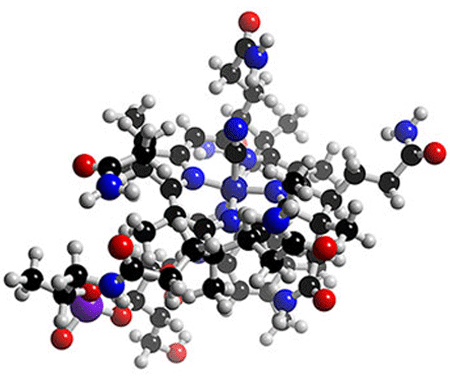
Vitamin B12

Today in Physical Medicine, we learned that injecting vitamin B12 into the infraspinatus muscle (located over the scapula, aka the shoulder blade), is used to treat asthma!  That's right: a vitamin... injected into a muscle... can help a respiratory condition... like asthma.  That body is so weird at times. Research papers supporting this theory are located here and here. 

Mechanism: it is believed that asthma is often due to a sulfite allergy. As a result, vitamin B12 (aka cobalamin) can help because it helps to produce a sulfite-cobalamin complex that blocks the action of sulfites in the body. It also decreases bronchospasms caused by sulfites due to its oxidative nature in the body.

2012-09-15

Physical Medicine.

The main naturopathic modalities that I will be using as a future ND include: nutrition (diet and supplements), botanical medicine, counseling, hydrotherapy, and physical medicine. 

When I first started at CCNM, and when these modalities were first introduced to me, I naively thought that physical medicine only consisted of massage and manipulation (aka chiropractic medicine). This year, however, I am learning that physical medicine is so much more! In third year, students take the course 'Physical Medicine'.  I've only had four classes of 'Phys Med' thus far, but boy have a I learned a lot of new therapies. 

Physical Medicine appears to be the best modality to body complaints; things like: sore muscles, sports injuries, strains, sprains, back pain, tension, nerve impingement, scars, etc. Phys Med involves a lot of pain management and techniques that encourage healing. 

Some of the Phys Med tools that we will be learning this year include (learning both theoretically and practically (i.e. hands on)):


Ultrasound: Not just an imaging technique, but a treatment too!  The ultrasound head sends sound waves through the tissue.  The sound waves cause internal vibrations, causing collagen re-growth promoting repair or increasing heat (heat is important in the tissue repair process, it means blood, hormones, growth factors, white blood cells (mast cells), and other repair elements are coming to the injury to fix it up). 

IFC (interferential current therapy): Very gentle electrical impulses are sent through the tissue surrounding the injury/pain. This low-frequency stimulation/vibrations causes the body to send healing factors (see above) to the site, helping to heal and relieve pain. 

Lasers: Similar to ultrasound and IFC, lasers use light beams to heal the damaged tissue/painful area by encouraging collagen regrowth and all those healing factors (see above) to the site. 


Who would of thought that sound, electrical current/vibration, and light could be so good for the body!

2012-09-13

Treament... and Dragons.


Real people with real health concerns. That is what this year is all about.  We are given cases in almost all of our classes. It is then up to us to come up with a diagnosis and a treatment plan (amongst other things, like what lab tests we should order, what next steps to take (future plan), etc).

For instance, today we talked about treating schizophrenia and anorexia nervosa using nutritional supplements. Yesterday, we talked about rhinitis (common cold) and influenza (flu) and how to treat these conditions using botanicals/herbs. Earlier in the week we talked about depression cases and using counseling/psychology as treatment. Lastly, we learned about muscle knots/trigger points and how to treat with either massage and acupuncture. It’s been quite the week of learning how to treat… and this is only the beginning.  I also love how naturopathic doctors have such big tool boxes; there are so many different ways (i.e. modalities) to treat one condition. 

Gone are the days of finding out what is wrong (diagnosis/pathology) and how it happened (pathophysiology). Here are the days of treating the root cause. I’ve officially reached the ‘treatment’ aspect of the curriculum. Yippee! 
_________________________________________________________


Image source here.

In other news, today I got to try some special acupuncture needling techniques today. For instance, we learned different ways to manipulate the needle while being inserted and removed in order to achieve different effects. I naively thought that there was only one way to 'jab a needle' into a body, but boy am I wrong.  There are tons of different techniques with funny names like 'building the mountain' and 'capture the dragon'.  Ha ha! Oh, TCM, you cease to amuse me.

2012-09-01

Cholera Outbreak.

Image source here.
In the news lately, there have been reports of a cholera outbreak occurring in Sierra Leonean. Sadly, this recent outbreak has cause over 300 deaths! It is the same disease that affected parts of Haiti (source).

What is cholera? Cholera is a disease caused by Vibrio cholerae, a microorganism that when ingested wrecks havoc in the small intestine, causing lots and lots of watery diarrhea (and vomiting). Cholera is spread by drinking water that has been contaminated by feces (in the case of Sierra Leonean and Haiti, this was likely due to mass flooding, mixing clean water with dirty, fecal matter-contaminated water). 

The most unfortunate part, is that even though hundreds of people are dying, the treatment to this disease is quite simple. The vomiting and diarrhea can lead to dehydration (loss of water).  Dehydration, when not treated, can cause death due to electrolytes being imbalanced (sodium, potassium, etc).  It is this dehydration/electrolyte imbalance that is killing people, not the Vibrio cholerae itself. The treatment for cholera is simply to correct the dehydration/electrolyte imbalance with sports drinks (like Gatorade), water mixed with honey, sea salt, and lemon, or the fancy oral rehydration solution. 

2012-08-30

Jet Lag Prevention?


Last year, I had one of my professors swear that in order to prevent jet lag, that you need to lie on the ground for 15-30 minutes once you've reached your destination.  He says you literally have to ground yourself.  By lying on the ground, you're aligning yourself (more specifically, your circadian rhythm) with the new rhythm of this new place. The weird thing is, he wasn't the only person to tell me this! I've had others swear by the technique.  It's only anecdotal evidence, which is less convincing; nonetheless, I am curious to try it next time I travel outside of my time zone.

Another natural jet lag prevention tool I've heard of is to take melatonin. Talk to your doctor if you suffer from jet lag often and want to give melatonin supplements a go. 
 
Question for the day: Anybody else heard of 'grounding yourself'? 
 
 
P.S. If you think that this jet lag theory is completely crazy, I can promise you that not all of my professors are this crazy :P 

P.P.S.  Yesterday, I talked about congee and how it's good to eat during Earth time and changes of season (according to TCM theories).  Well, late last night, I stumbled across this restaurant in Toronto: Congee Time! A restaurant devoted to congee (and other Asian cuisine delicacies). They serve ~20 different types of congee.  I definitely want to try the Taro and Sweet Corn congee that I spotted on their menu. Also speaking of congee, I have made this flavor before, sans chicken.  Which I highly recommend especially if you like sesame oil. Mmm.