Showing posts with label Clinical Medicine. Show all posts

2013-04-29

Differentiating Some Causes of Chronic Pain in Women

My grandmother and I were chatting about different chronic pain disorders that exist in women. Here is a very brief overview of three common conditions, highlighting their differences and unique symptoms. All present with muscle pain and more often in women. 


Fibromyalgia 
- often presents in younger women (less than 40)
- point tenderness over affected muscles 
- tender points in various locations on the body (11-18 tender points total)
- anxiety and stress exacerbate the pain 
- often associated with depression and chronic fatigue syndrome
- often normal laboratory values
- may be due to mitochondrial dysfunction, though many hypotheses exist


Polymyositis
- often presents in women aged 40-60 
- weakness, stiffness, and inflammation of proximal muscles 
- severe pain and stiffness felt in pectoral and pelvic girdles 
- may have difficulty swallowing, lung disease, and thickening of skin
- elevated ESR and CPK laboratory test values 
- anti-jo antibodies found


Polymyalgia Rheumatica
 - often presents in women older than age 50 
- severe pain and stiffness felt in hip, neck, pelvis, shoulder
- inflammation seen in many muscles
- temporal arteritis can also present
- "gelling phenomenon" experienced (stiffness after inactivity) 
- elevated ESR and CRP laboratory test values

2013-03-10

Monday Morning Dangers

It's beginning to feel like Spring here in Toronto! Today is 12*C and partially sunny. With daylight savings occurring today, that means we'll get to enjoy this sunshine thanks to more daytime hours.

With that said, please be careful driving to work tomorrow. The morning after the Spring daylight savings time adjustment is one of the most dangerous times to drive, as I discussed last year.

Secondly, because tomorrow is Monday, be extra easy on yourself, as research shows that the incidence of heart attacks is highest on Monday mornings. This paper concludes that: "The incidence of sudden cardiac death is markedly increased on Monday". 

The day after daylight savings plus the fact that it is a Monday = one very dangerous day

So take care of yourself tomorrow morning, dear reader. Take care! 

2013-03-06

Did you know that there are organs on your face?

In Chinese Medicine, the face can be mapped by organ systems. This is may be useful for understanding the cause of acne, moles, wrinkles, sun spots, etc. First, a naturopathic doctor or doctor of traditional Chinese medicine determine will determine where is the acne/mole/wrinkle/spot is located on the "TCM Face". Second, the doctor will ask questions to see if the corresponding TCM organ is dysfunctioning. For instance,   for chin acne, they may ask about urination frequency, urine color, urine smell, the amount of water you drink, etc. 

Obviously this is one theory behind face "imperfections". At CCNM, we actually aren't trained in face reading; the image below is just something I came across online that falls in-line with Chinese Medicine principles and I personally like the theory. So please don't go thinking that all NDs are hokey-pokey, fortune-telling, face-readers because they most definitely are not trained to act this way!

I have heard from a Western perspective, however, that jaw line acne is a result of hormonal imbalance. Evidence comes from research on polycystic ovarian syndrome (PCOS); a disease in which androgen hormones are in excess and jaw and chin acne can be symptoms (note that there are other defining PCOS symptoms; please talk to you doctor/health care provider if you are curious about the diagnosis of PCOS). 

Image source here

2012-11-30

Fatigued?


We have learned that when a patient walks into your office and says "my chief concern is fatigue", we have to ask a bunch of questions to understand what they actually mean by fatigue.

What does fatigue mean to the patient? Does it mean:

 ...tired? ...sleepy? ...physically exhausted? ...apathetic? ...depressed? ...is there lassitude?


The descriptors above would each point the doctor towards a different diagnosis so it is very important to ask the right questions to make that sure he or she is going in the right direction when a patient presents with fatigue. 

Several examples of questions that may be asked to help determine the diagnosis: 

- Are you still fatigued after a good night of sleep?
- Do you feel well rested in the morning?
- Do naps help the fatigue?
- Tell me about your sleep. Is your sleep of adequate quantity and of good quality?
- Does the onset of the fatigue happen at the end of the day?
- How is your mood?
- How is the fatigued changed by exercise? Increased or decreased?
- Tell me about your diet. Are you consuming adequate calories, nutrients, and iron?
- Do you drink caffeine? How much and when?
- Etc, etc...

2012-11-13

Pregnancy Tests and Testicular Cancer

An amazing example of the power of online communities...

Last week, I girl posted a funny comic to the online community Reddit about her male friend who used his girlfriend's unopened pregnancy test to jokingly see if he was "pregnant". The funny part of the comic was that the pregnancy test was positive! You may be thinking: Ha, ha. Guys can't be pregnant, what a faulty test... 

Wrong attitude! There is validity behind a male testing positive on a pregnancy test. 

Pregnancy tests (the ones you urinate on and wait for the blue line to appear or not), test the level of the hormone human chorionic gonadotropin (hCG) in the urine. In pregnant females, the level of this hormone drastically increases after ovulation; hCG levels increase so much that some spill into the urine, hence why pregnancy tests are able to pick it up (within 6 and 12 days after ovulation).

However, hCG has more roles in the body than simply being used as a pregnancy marker. In fact, hCG  is a great cancer marker for some cancers (cancers of sex organs, such as those affecting the ovaries, uterus, and testicles). Therefore, if a male takes a pregnancy test and it tests positive, it may indicate that he has testicular cancer. 

...so, back to our story: after the "funny" comic was posted to Reddit, tons of comments were posted advising the original comic poster that the man who took the pregnancy test should go see a doctor to be screened for testicular cancer. The girl who posted the comic replied saying that she had no idea that this was serious; she simply thought it was funny! Nevertheless, she immediately contacted her male friend and he went to the doctor.  Low and behold: he had a small tumor present on his testicle! She posted his results to Reddit and thanked the community for their diagnostics skills. The male and the original comic poster were both from Hamilton, Ontario, by the way.

Quite the story, right? Read the whole story (which made the national news) here.

2012-11-04

Brrrrr and Babies.

Today I dug out my Winter jacket and made myself a mug of Gingerbread tea.  It felt a bit early, but it is November. I guess it is an appropriate time to start wearing Winter gear, especially since the temperature today was only 2*C. Brr, 'tis the season for warm outerwear! Anyone start listening to holiday music yet?


In my Clinical Nutrition class last week, we talked a ton about vitamin C.  One super interesting tid-bit taken from the class was that some incidents of Shaken Baby Syndrome are not necessarily due to child abuse, but are hypothesized to be due to a deficiency in vitamin C.  You can read some research on the topic here. It's obviously a very controversial hypothesis; nonetheless it was an interesting topic to have discussed in class.  

2012-10-01

Monday Highlights.

Image source here.

Today was a brain-bursting kind of day.  Lots of cool info all packed into one (typically) boring Monday! Some highlights:

- How to determine if a seed is still fresh (e.g. cumin seeds, mustard seeds, anise seeds, parsley seeds, etc): chew on one! If it tastes woody and not flavorful, then the seed is old and the medicinal volatile oils have evaporated or degraded.
- Classmate says to professor: "How do you reduce male pattern baldness?" Professor's response: "If I knew the answer to that question, I'd been lounging on an island right now".
- People with kidney stones are often dehydrated and deficient in vitamin B6 and magnesium. Supplement these nutrients or eat foods rich in them.
- Apitherapy (apis = bee) is a technique used by some (not NDs! We just learned about it for fun) to treat rheumatism arthritis. It involves stinging a patient's rheumatic/flared-up joint with a live honey bee!  Apparently the bee sting is enough for the immune system to stop attacking the body's own joint and focus on the bee sting instead.  Repeated stinging yields best results.
- Another reason to supplement vitamin D this Winter: new research reveals that vitamin D is precursor in the tumor fighting pathway of the body.
- When blood sugar levels reach 9-10 mmol/L, the sugar (glucose) spills into the urine, giving urine a sweet smell and taste... yes, taste. Before the invention of urinalysis, doctors used to taste their patient's urine to assess for sweetness and thus diabetes.
- Lastly, I got to play doctor and interview a patient today during Primary Care. In addition to asking a million questions, I also had to chart my findings (aka complete a medical record) and perform relevant physical exams on the patient. It was a great experience and I was proud of my performance (not sure what the prof thought, doesn't matter though, I'll see my evaluation in two weeks).  Anywho, the point of this story: I think I've picked the right profession when I find taking a case to be "fun" :)

2012-09-19

The Female Heart Attack.

Did you recently hear about celebrity Rosie O'Donnell's heart attack?

Her story details an important concern for females: heart attacks symptoms commonly experienced by women are not typical.  By typical, I mean those characteristic heart attack symptoms of chest pain, shortness of breath, pain radiating to the the shoulder/left arm, etc.

Heart attack (myocardial infarctions) in females cause symptoms such as (but not limited to!): nausea, sweating, fatigue, upset stomach, flushing, indigestion, weakness, shortness of breath, dizziness, anxiety, etc. However, also note that some females also experience the 'typical' symptoms as well.

The heart can be deceiving... (Binary Heart, from XKCD.com).

2012-08-21

Torturous Veins.

Image source here.
See these blue markings on the thigh of this person?  They are called varicose veins or more commonly referred to as spider veins.  They are simply dilated veins, containing some stagnant deoxygenated blood (the blue kind!). They are the result of venous insufficiency (meaning that the veins aren't particularly good at returning blood to the heart; in fact it's actually not entirely the veins' fault because they have to work against gravity and don't contain as much muscle as arteries do). When a vein dilates to accommodate pooled blood, it becomes all curvy in shape, or in the medical world, we call this shape torturous. My, what a name! It sounds so harsh. Oh, how lovely: I have torturous veins on my leg.

From what I've learned, varicose veins are benign, meaning they cause you no harm other than esthetically they can be bothersome. One way to treat varicose veins is to wear compression socks and to elevate the feet everyday to drain the pooled blood from the legs.  Yep, varicose veins give you a real reason to "put your feet up" at the end of the day!

2012-08-12

Babinski.

Image source here.
The Babinski test is a fun little test I learned about in first year, during my practical physiology tutorials.  I think it is a cool concept and couldn't believe that I hadn't shared it on the blog yet! 

The Babinski test consists of someone stroking the lateral side---of the bottom of the foot, going in the direction of the heel to the toes---with a blunt but somewhat sharp object.  (If you want to try this test at home, perhaps you could use a capped pen or a smooth chopstick? Doctors often use the end of their reflex hammer to preform this test).

When the foot is stroked in this matter, the normal adult reflex is for the toes and foot to all curl downwards (a motion termed plantarflexion), as seen in image A

However, in people with upper motor neuron lesions of the corticospinal tract (i.e. people who have had a part of their spinal cord damaged), there response will be much different. Instead of the toes curling, they will fan outwards, and the big toe with extend backwards (a motion termed dorsiflexion), as seen in image B. If patients are experiencing neurological or motor abnormalities, the Babinski test can be preformed to potentially narrow down the location of the spinal cord problem.

The coolest part of the Babinski test is that when it is preformed on babies, their toes will fan out just like image B.  This is because their corticospinal pathways haven't fully developed yet (they are not yet myleinated). In the healthy baby, this abnormal reflex will disappear sometime before his or her second birthday.  

Any readers with babies should give the Babinski test a try.  It's a reflex that your babe will only have for so long!

2012-08-05

Womanly Wonderings.

Note: the information in this particular post is completely derived from my own medical-mental processing, and therefore I could be totally wrong! I'm hoping that next year, in my Women's Health class, I'll have these questions answered. In the meantime, here are my wonderings as I try to connect the dots in my head.

While I was studying the reproductive organ chapter of my NPLEx prep book, I starting putting concepts together and started asking questions. As a result, I came up with these three womanly wonderings:


In order to metabolize and excrete estrogen hormones from the body, the liver has to conjugate the estrogens.  And in order for the liver to conjugate the estrogens, it has to have a good supply of B-vitamins to serve as co-factors in the conjugation reactions.  

Womanly wondering #1: Is this why so many NDs prescribe B-vitamins (aka B-complexes) to menstruating females suffering from PMS and bad menstrual cramps? Are the B-vitamins prescribed to support the liver and the excretion of estrogens? 

__________________________ 

Estrogen and progesterone (the female hormones) levels drop in menopause not because they can't be made anymore, but because a menopausing female doesn't have any more follicles left in her ovary and it is the follicle that stimulates the release of estrogen and progesterone.

Womanly wondering #2:  Is this why every female enters menopause at a different time, because it depends on when their follicle supply runs out? (For instance, all women don't just immediately start menopause on their 50th birthday; the start date is so variable). If so, do the women with more follicles than others, not enter menopause until later in life? 

__________________________

A magnesium deficiency can causes muscle problems, such as cramps (among other symptoms). 

Womanly wondering #3:  Is this why some menstruating females get cramps, because they are deficient in magnesium? Hmm, chocolate is a food source of magnesium, is this also why some menstruating females crave chocolate? Because their bodies want the magnesium stored in the chocolate? 

2012-07-27

Pox Party.

Image source here.

What's with all the parents rushing to take their kids to Chicken Pox Parties?  

 You know, those parties in which parents bring their kids to the house of the one sick child (who is sick with Chicken Pox), in hopes that all kids in attendance get infected too. Yep, those parties really exist and they have officially been named Pox Parties.

Chicken Pox is caused by the herpes virus Varicella Zoster.  It is self-limiting (meaning it will cure itself, no drugs required, especially not Aspirin (it can cause grave health consequences if used... or so my NPLEX study manual has told me so)). However, it is not a comfortable infection: the child will be covered in a rash and will be quite itchy.  I remember my Chicken Pox experience: I was mortified at the way my skin looked and was perturbed that I had to keep taking baths (to prevent secondary infection of my bumps and to sooth the itchiness).

Getting infected with Zoster seems to be a normal part of growing up. The purpose of a Pox Party is to get children innoculated with Zoster when they are young and have stronger immune systems. The parents' reasoning makes sense to me because adult infections with this virus are quite severe!  (Note: I've read, however, that some Medical Doctors (MDs) still advise that children simply get vaccines against Zoster rather than attending a Pox Party, per say. Talk to your doctor and do your own research to find out what is best for you and your child. This post is not meant to act as medical advice!).

A complication of Zoster is shingles.  Shingles can develop in an adult with the virus, or it can even occur in someone who already had been exposed to the virus as a child (not fair, huh? :P).  That being said, reactivation of the Zoster virus usually happens in immunocompromised (weak immune system) or already very sick and weak individuals and not usually in regular 'ol healthy Joes.  Shingles is an extremely painful condition as the virus lies in the nerve roots (deromatome) lining the chest wall, and its presence here aggravates the nerves, causing painful, hot, and burning sensations.

2012-07-25

The Female Cycle.

As promised, today I'm going to explain the painting I showed yesterday on the blog.  Your guesses were correct: the painting was of the menstrual cycle, but in much more depth.

Painting inspiration here.

A tad overwhelming upon first glance?  Yeah, I got kind of carried away with the doodling... 

Here's another breakdown: 

Yellow: the ovarian cycle, featuring the maturation of the follicle, ovulation at day 14, and formation of the corpus luteum.

Orange: the basal body temperature changes in a menstruating female.  When the body ovulates, the temperature rises about 0.5 to 1 degree Celsius higher and remains elevated for the remainder of the cycle, eventually dropping back to the regular body temperature at the end of the 28 days. Note: the basal body temperature is best measured in the morning, immediately upon waking (don't even get out of bed!), using an oral thermometer.  Measure subsequent temperatures at the same time each morning. 

Green: the anterior pituitary hormones' cycle. FSH = follicle stimulating hormone, and LH = luteinizing hormone.

Blue: the ovarian hormones' cycle. Estrogen and progesterone. 

Red: the uterine cycle. The shedding, then the thickening of the uterus lining.

Black: menstrual bleeding days. Note: the full menstrual cycle begins (i.e. day 0) on the first day of bleeding. Bleeding is not the end, but the beginning of everything you see in the painting above!

Brown: non-bleeding days.  

Note: notice how everything changes on day 14? I call this the 'magic day' because ovulation changes everything cycle-wise.

2012-07-23

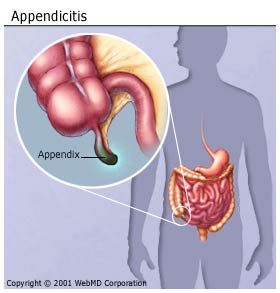
The Appendix.

The appendix is a sac-like structure lying along our digestive tract (specifically located at the junction between the small and large intestines). Although it's function is debatable and largely unknown, it presumed to have once had a role in our immune system because it is full of lymphoid tissue (which is found in all other immune system-related organs/structures in the body). It is thought that the appendix used to contain bacteria to help humans digest plant matter (remember: we can't eat grass because of their cellulose (beta 1-4 linkages) content). Perhaps the appendix was a more frequently used organ when we were primates, feasting on leaves and such.

Image source here.

Often people have their appendix removed (called an appendectomy) when they are diagnosed with acute appendicitis. This is when the appendix is inflamed and the patient experiences a great deal of abdominal pain.  The pain starts vaguely/diffusely around the belly button, and then moves to a particular point between the belly button and the right hip bone (this halfway point is called McBurney's Point). One of the key questions to ask a patient with hypothesized appendicitis is whether or not the pain moved. Appendicitis is considered a medical emergency because without treatment it can lead to shock if the appendix were to rupture.

2012-07-22

Tea Tree Oil.

Probably the most widely available version of Tea Tree Oil is made by Thursday Plantations.

Every naturopathic first-aid kit should contain a bottle of tea tree oil. I really love tea tree oil and think everyone should have a bottle on hand, especially during Summer months which tend to be full of scraps, cuts, dirt, soap-less public bathrooms, camping, car trips, etc.

Product: Tea tree oil is just that, an oil. An essential oil, to be exact. You can buy little bottles of it that can be carried in the car, in a purse, or easily stored in a medicine cabinet or first-aid box. It is not very expensive either: a bottle will cost between $10-15 and will last a long time.

Mechanism: Tea tree is basically a natural antibiotic.  The oil has been shown to be anti-microbial, anti-bacterial, anti-viral, anti-yeast, and anti-fungal. 

Uses: In a nut shell: it is great for sanitizing/sterilizing, cleaning, and preventing infections. It is to be used topically, meaning it can treat infections and/or damage to the skin. I've used tea tree oil when cleaning products (add a couple of drops to soaking water, to mop buckets, when making homemade cleaners, etc). In addition, I've applied it to my skin a bazillion times to treat various conditions and simply as a form of hand-sanitizer when soap was unavailable. You can even add it to your shampoo (especially if making homemade shampoo) and some make homemade mouthwash using a combo of tea tree oil, baking soda, etc.

Warnings: the oil is quite potent and a little goes a long way, so most oil companies advise (on their bottles) that their product be diluted with water or another oil (like olive oil).  So you could pour a bit of olive oil in a dish then add some drops of tea tree oil, mix, then apply to the area needing treatment and/or cleaning.  Another thing to note: the scent of tea tree oil is extremely potent!  It sure smells medicinal :P  Be prepared for the strong herbal smell.  The smell isn't a bad thing, however.  Inhaling small amounts of the stuff (at a distance or diluted with water, try not to directly inhale the stuff) is like providing an anti-microbial treatment for your lungs (good for congestion and respiratory sicknesses like colds/coughs/sinus problems).  Last note: don't eat tea tree oil.  There are tea tree oil-containing mouth washes, toothpastes, and dental flosses, so having it in your mouth should be totally fine, just don't swallow the stuff :P

2012-07-17

Three Weeks!


The essentials: CCNM mug (with herbal tea), bright highlighters, and NPLEX study manual.

Three weeks until D-Day (aka the day I write my NPLEX exam)! 

Here's what I've been staring at lately (clockwise from the top left): arteries of the body, female hormone/menstrual cycle, back muscle (erector spinae in particular), and heart defects (tetralogy of fallot in particular).  

Ugh...anyone want to trade places? Ha ha. 


Image source here.
Image source here.


Image source here.
Image source here.

2012-07-14

Saturday Studying.

My Saturday Studying has taught me that...

- Humans possess between 600-700 lymph nodes.
- Fat is moved around our body via the lacteals of our lymphatic system
- Progesterone is a female hormone that causes the basal body temperature of the body to rise during ovulation.  This is extremely helpful for females trying to conceive. They are able to track their basal body temperature (i.e. take the temperature each morning while they are still in bed using an oral thermometer. When they see a rise in temperature, they know they've ovulated).
- Our thyroid gland sits in our neck, but is actually derived from our tongue.
- Alcohol inhibits our anti-diuretic hormone (ADH).  Anti-diuretic = anti-urine = less pee. But when ADH is prevented from doing its job, we pee more.  Hence the needs to run to bathroom more frequently while drinking.
- Tyrosine is an amino acid required to melanin, our skin's pigment.  Albinos (think white hair, very pale skin) have a problem with their tyrosine metabolism.  No tyrosine = no melanin = no skin or hair pigment. 

What did you learn today?

2012-06-27

Tennis/Tetanus Talk.


Tetanus is an infection caused by Clostridium tetani. The name tetani/tetanus comes from the shape of this bacteria.  It is rod shaped, but with a round spore at one end. This shape looks like a tennis racket, hence the name tetani. C. tetani lives prodominately in the soil. Humans contract the bacteria from the soil when something that is soil covered penetrates the body (such as a nail that was once outside).  Contrary to common belief, the rustiness of the nail is not what we should be afraid of, but the soil covering the end of the nail!

When C. tetani enters the body, it starts making a toxin. This toxin enters the nerves of the central nervous system and prevents the nerves from being turned off (it blocks the release of inhibitory neurotransmitters, for those super nerds who are curious :P). When the nerves can't "turn off" the continue to fire and those in muscles can become paralyzed in an active form (i.e. the contracted form of the muscle).  

One of the first muscles to be affected by the tetanus toxin is the masseter muscle in the face.  This muscle allows us to chew our food and clench our job.  As such, if the masseter becomes stuck in it's contracted form, a person will suffer from "lock-jaw".

2012-06-22

Shock, Explained.

*Nerd Alert!* Today's topic is quite science-y and medically, but (hopefully) still interesting! 

Have you heard of people going into shock?  Shock signifies cardiovascular collapse. Blood has stopped pumping. Blood is not reaching vital organs. The circulatory system (basically) shut down. Shock can be triggered by a loss of blood (aneurism, cut, trauma, etc), a major loss of fluid (diarrhea, vomiting, dehydration, etc), an allergy (anaphylactic), or due to a spinal cord injury. 

Here is an overview of what is going on:

- The shock pathway starts with a loss of blood or fluid triggers hypovolemia (body senses a low volume) OR...
...an allergy or spinal injury triggers vasodilation (dilation of the veins) in the body
- Either of these triggers (vasodilation OR hypovolemia) cause decreased blood flowing back to the heart (because all of the blood is pooling in the dilated veins away from the heart OR there is not enough fluid to have blood go back to the heart)
- With a decreased amount of blood going to the heart, the heart rate decreases, meaning less blood is being pumped overall.
- Without blood, the body dies! Death from circulatory failure. Thus compensatory mechanisms kick-in as soon as the body reaches the "shock" status.
- Blood vessels in non-vital organs and body parts constrict, preventing blood from going to these parts, saving what blood remains for the vital organs.  This is why shock patients look pale and the skin feels cold/clammy; blood has been diverted away from the skin and blood is what our skin warm and flesh-toned (in the case of Caucasions).
- The kidneys try to conserve water by decreasing the amount of water that leaves the body via urine (uremia).
- If the root problem isn't fixed, taking the body out of a state of shock, then the patient can die from circulatory failure.  Before death, however, parts of the body can start to die from lack of blood (necrosis, seen most notably the intestines and the lungs).

2012-04-25

Pricey PLEX.

And just as school winds down (only one more exam (out of a total of nine exams) left!)...

...school (well, learning at least) seems to be starting up again.
 
I'm taking about NPLEX.  After we second years emerged from our big exam this morning (on that note: goodbye Clinical Med! It's been one hell of a year knowing 'ya!), it was time to start thinking about NPLEX, our board exam to be written in August.  Student Services had us signing up for the course, giving us payment instructions, and selling prep manuals.  To my utter shock, I learned just this morning that writing NPLEX ain't cheap.  You have to pay almost $500 just to write the exam, plus you have* to buy the prep manual ($15), plus you have* to buy the study manuals ($150), plus you have* to take the prep course ($225). That's almost a grand for just NPLEX 1. Yikes! I can't imagine how pricey NPLEX 2 is, seeing as this exam is written over multiple days and has different prep courses for different parts of the exam.

*Note: You technically don't have to buy the prep manual, study manual, or take the course.  But if I'm paying $500 to write this massive exam, then I only want to have to write it once; I don't want to fail!  However, most students buy all three of the resources listed above, and then some; I feel good about my minimal purchases. 

In more positive news, check out my new school apparel.  Stylish school pride!  The photos were taken on my phone, so the true color does not look its best. Front, back, and crest close-up.